
Your Camarillo Home Needs More Than Attic Insulation: A Complete Thermal Barrier Guide
Most Camarillo homeowners think about insulation once, usually after a sky-high summer utility bill. But a home’s thermal envelope has two critical weak points: the attic above and the crawl space below. Fix one and ignore the other, and you’re still losing conditioned air, inviting moisture problems, and leaving money on the table every month. This guide walks through both systems so you can make informed decisions before calling a contractor.
Why Camarillo’s Climate Makes Insulation More Complicated Than You’d Think
The Summer Attic Heat Problem
Camarillo sits in a microclimate that surprises many homeowners. The coastal marine layer keeps mornings mild, but afternoon temperatures climb quickly, and attic spaces absorb radiant heat from roof decking that can push interior attic temps well above ambient outdoor readings. When insulation is undersized or degraded, that stored heat radiates through your ceiling into living spaces for hours after sunset. Your air conditioner runs longer, cycles more frequently, and wears out faster.
The California Building Code sets minimum R-value requirements for attic insulation in Climate Zone 6 (which covers Camarillo), but minimum is not the same as optimal. Many older homes in the area were built to standards that predate current energy codes, meaning the insulation already in place may be both undersized and degraded from age, rodent activity, or moisture exposure.
Winter Performance: The Overlooked Half
Because Camarillo winters are mild by most standards, homeowners often assume insulation is a summer-only concern. It isn’t. Properly installed attic insulation slows heat transfer in both directions. During cool nights and chilly mornings, a well-insulated attic keeps conditioned warmth inside rather than letting it escape upward. Homes with thin or damaged insulation work their heating systems harder during those overnight hours than most owners realize.
Humidity and the Marine Layer Factor
Camarillo’s proximity to the coast means humidity swings are real. The marine layer pushes moisture inland, and that moisture can accumulate in attic spaces and crawl spaces if ventilation and vapor control are not properly managed. Moisture-laden insulation loses R-value, becomes a substrate for mold growth, and can contribute to wood rot in framing members. Addressing humidity is not optional; it’s part of any honest insulation evaluation.
Attic Insulation Materials: Matching the Right Product to Your Home
Blown-In Fiberglass and Cellulose
Loose-fill materials are the workhorses of attic insulation installation in Camarillo. Blown-in fiberglass and cellulose both conform to irregular joist bays, fill around obstructions like wiring and blocking, and can be added on top of existing insulation when the current layer is sound. Cellulose is made from recycled paper fiber treated with borate-based fire retardants, giving it good performance in tight spaces. Fiberglass loose-fill resists moisture absorption slightly better, which matters in attics with any history of condensation.
The right choice depends on your existing conditions, your attic’s ventilation configuration, and whether any remediation work (rodent cleanup, mold treatment, old insulation removal) needs to happen first. A qualified attic insulation contractor in Camarillo will assess those conditions before recommending a material.
Batt Insulation: Where It Works and Where It Doesn’t
Fiberglass batts are common in new construction and in attics with clear, consistent joist spacing. The problem is installation quality. Batts that are compressed, improperly cut around obstructions, or left with gaps at the edges perform significantly below their rated R-value. In older Camarillo homes with irregular framing or previous rodent activity, batts are rarely the best choice for an attic floor application. They work well, however, in specific applications like knee walls and attic hatches where a rigid, fitted product is appropriate.
Spray Foam for Air Sealing
Open-cell and closed-cell spray polyurethane foam serve different purposes. Closed-cell foam has a high R-value per inch and acts as a vapor retarder, making it useful in specific locations like rim joists and around penetrations. Open-cell foam expands dramatically and seals air gaps effectively but is vapor-permeable. Neither is typically the primary insulation material for an entire attic floor, but both are valuable tools for air sealing before blown-in insulation is applied. Air sealing and insulation work together; adding R-value without sealing bypasses around light fixtures, plumbing penetrations, and top plates leaves a significant portion of potential savings unrealized.
Crawl Space Insulation: The System Most Camarillo Homeowners Ignore
Vented vs. Encapsulated Crawl Spaces
This is where crawl space performance gets genuinely interesting. Traditional building practice called for vented crawl spaces: foundation vents allow outdoor air to circulate underneath the floor, theoretically drying out any moisture. The problem is that in coastal California climates, outdoor air is often more humid than the air inside the crawl space, especially during summer mornings when the marine layer is thick. Venting can actively introduce moisture rather than remove it.
Encapsulation takes the opposite approach. A heavy-duty polyethylene vapor barrier (typically 10 to 20 mils thick) is sealed to the walls and floor of the crawl space, foundation vents are sealed, and the space is treated as a semi-conditioned zone. Insulation is then applied to the crawl space walls rather than the subfloor above. This approach dramatically reduces moisture intrusion, keeps the floor system warmer in winter, and can improve indoor air quality by limiting the amount of ground-sourced air that migrates up through floor gaps into living spaces.
Vapor Barriers: What the Specs Actually Mean
Not all vapor barriers are equal. A thin 6-mil poly sheet stapled loosely to the ground is a starting point, but it tears easily, allows moisture to migrate around seams and edges, and provides no protection to the walls or rim joists. A properly installed encapsulation system uses reinforced poly rated for durability, sealed at all seams with appropriate tape, and run up the foundation walls and secured at the sill plate. Penetrations for pipes and posts are sealed individually.
The thickness rating matters because crawl spaces see foot traffic during inspections and maintenance. A barrier that tears every time someone crawls through to service a plumbing line quickly becomes ineffective. Investing in a heavier, properly installed liner is more cost-effective over the long run than repeatedly patching or replacing a thin one.
Insulating the Subfloor vs. the Walls
In a vented crawl space, insulation typically goes between the floor joists above, with batts held in place by wire supports or netting. This keeps the floor system within the thermal envelope. The challenge is that batts in a vented crawl space are exposed to the same humidity cycles as the rest of that space, and they can sag, fall, or absorb moisture over time.
In an encapsulated crawl space, rigid foam board or spray foam applied to the foundation walls is more common. This brings the entire crawl space inside the thermal boundary, protects the insulation from physical damage, and avoids the sagging-batt problem entirely. The best approach for a given Camarillo home depends on the existing foundation type, the presence of any standing water history, and whether the crawl space is accessible enough for full encapsulation work.
How Attic and Crawl Space Performance Connect
Stack Effect and Air Movement
Warm air rises. In a home with a leaky attic and an uninsulated or poorly sealed crawl space, a pressure-driven loop develops: warm air escapes through the attic, and replacement air is drawn in from below through the crawl space. This stack effect pulls unconditioned, potentially humid air from under the house up through floor gaps, into wall cavities, and out through the attic. Sealing and insulating both ends of the home addresses the root cause rather than just one symptom.
HVAC Efficiency and Duct Performance
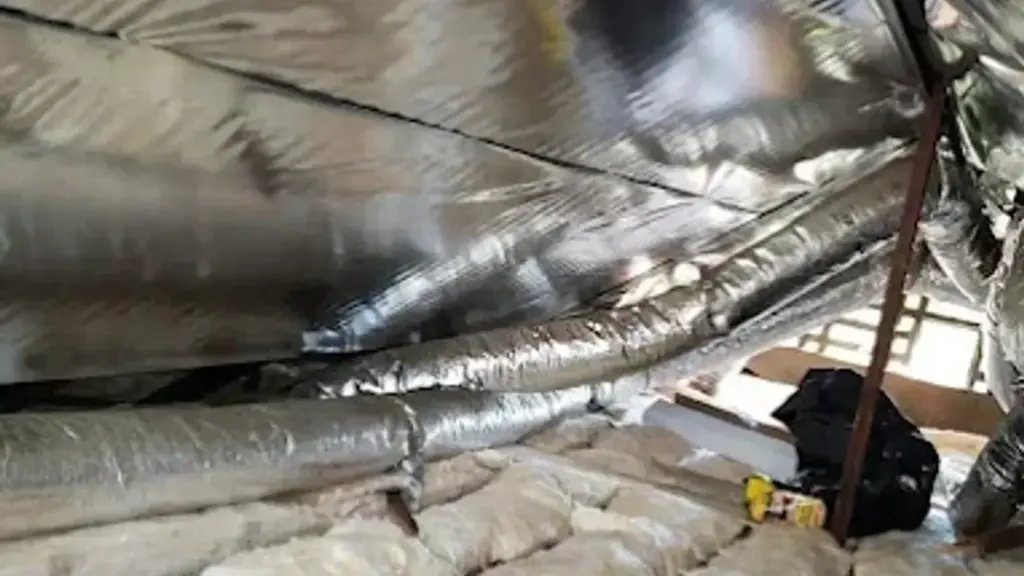
Many Camarillo homes have HVAC ducts running through either the attic or the crawl space. Ducts in unconditioned spaces are subject to the full temperature extremes of those zones. An attic duct surrounded by 140-degree air in August is delivering air that has absorbed heat before it even reaches a register. Properly insulated and air-sealed ducts, combined with a well-insulated attic, reduce that heat gain significantly. If you’re scheduling an attic insulation service in Camarillo, it’s worth having the duct system evaluated at the same time.
Moisture’s Effect on R-Value
Fiberglass and cellulose both lose effective R-value when wet. A nominal R-38 attic assembly that has absorbed moisture from a roof leak or condensation event may perform closer to R-20 or lower in the affected areas. The same applies to crawl space batts that have been exposed to ground moisture or condensation. This is why a visual inspection matters before adding new insulation on top of existing material. Covering wet or damaged insulation traps moisture and creates conditions for mold and wood decay.
Signs Your Camarillo Home’s Insulation Needs Attention
Performance Red Flags Inside the Home
- Rooms that never seem to reach the thermostat setpoint, especially second-floor spaces directly below the attic
- Floors that feel noticeably cold in winter, particularly over a crawl space
- Utility bills that have increased without a corresponding change in usage habits
- HVAC equipment that runs almost continuously during moderate weather
- Humidity levels inside the home that feel higher than expected, especially in lower floors
Physical Conditions Worth Inspecting
- Visible gaps or thin spots in attic insulation, especially near the eaves and around penetrations
- Insulation that appears discolored, compressed, or matted (signs of moisture or age)
- Evidence of rodent activity: droppings, nesting material, or tunneling through insulation
- Vapor barrier in the crawl space that is torn, displaced, or missing entirely
- Standing water or persistent dampness in the crawl space after rain
- Wood framing in the crawl space that shows staining, soft spots, or visible mold
Comparing Crawl Space Treatment Approaches
| Approach | Best For | Key Advantage | Key Limitation |
|---|---|---|---|
| Basic ground cover (6-mil poly) | Dry climates, low moisture exposure | Low upfront investment | Tears easily, no wall coverage |
| Subfloor batt insulation | Vented crawl spaces, moderate climates | Familiar material, easy to add | Sags over time, exposed to humidity |
| Full encapsulation with heavy liner | Humid or coastal areas, Camarillo homes | Moisture control, improved air quality | Higher upfront cost, requires sealing vents |
| Encapsulation + wall insulation | Homes with ducts or HVAC in crawl space | Brings crawl space into thermal envelope | Most involved installation |
What to Expect When You Hire a Contractor
The Inspection Phase
A reputable contractor will not quote a job without physically inspecting both the attic and the crawl space. In the attic, they should measure existing insulation depth at multiple points, check for air sealing deficiencies around penetrations and top plates, look for signs of moisture or pest activity, and evaluate ventilation (soffit vents, ridge vents, or power ventilators). In the crawl space, they should assess the existing vapor barrier condition, check for standing water or moisture staining, evaluate the subfloor framing for damage, and note any duct conditions.
An inspection that takes less than 20 to 30 minutes across both spaces is probably not thorough enough to produce an accurate scope of work.
Scope of Work and Material Specifications
Before any work begins, you should receive a written scope that specifies the insulation material, the target R-value, the vapor barrier thickness and brand (for encapsulation), and what preparatory work (old insulation removal, air sealing, rodent cleanup) is included. Vague scopes lead to disputes. A clear document protects both you and the contractor.
For attic insulation installation in Camarillo, the scope should also note whether existing insulation is being supplemented or fully replaced, and why. Adding blown-in insulation over sound existing material is reasonable. Adding it over rodent-contaminated or moisture-damaged insulation is not.
Post-Installation Verification
After installation, you should be able to verify the attic insulation depth with a simple ruler at several points. Most contractors will leave depth rulers (small plastic markers) embedded in the insulation for this purpose. For crawl space work, a walkthrough or photo documentation of the completed liner installation, including sealed seams and wall coverage, gives you confidence the work was done correctly.
Frequently Asked Questions
How do I know if my Camarillo home’s attic insulation is adequate?
Measure the depth of existing insulation at several points across the attic floor. Compare that depth to the R-value chart for the material type (fiberglass loose-fill, cellulose, or batts all have different R-values per inch). California’s Climate Zone 6 requirements are a useful benchmark, but many older Camarillo homes fall well short. A contractor inspection will give you a more complete picture, including air sealing gaps that depth alone won’t reveal.
Is crawl space encapsulation worth it in Camarillo’s climate?
For homes with any history of crawl space moisture, musty odors on lower floors, or HVAC equipment located in the crawl space, encapsulation is generally worth serious consideration. Camarillo’s coastal humidity makes ground moisture intrusion a real risk, and a properly sealed crawl space reduces that risk significantly compared to a vented space with only a basic ground cover.
Can I add new attic insulation over old insulation?
Sometimes. If the existing insulation is dry, intact, and free of rodent contamination or mold, adding blown-in material on top is a cost-effective way to increase R-value. If the existing insulation is damaged, contaminated, or wet, it should be removed first. A contractor inspection will determine which situation applies to your home.
How long does attic insulation installation typically take?
A straightforward blown-in attic insulation job in an average Camarillo home typically takes a single day. Jobs that include old insulation removal, air sealing, or crawl space encapsulation will take longer, sometimes two to three days for a comprehensive project. The inspection and scoping phase happens before scheduling, so there are no surprises on the day of installation.
Does insulation affect indoor air quality?
Indirectly, yes. A properly sealed and insulated crawl space reduces the amount of ground-level air, along with any moisture, soil gases, or biological material it carries, that migrates into living spaces. Sealing attic bypasses reduces the pull of unconditioned attic air into the home. Neither is a medical treatment, but homeowners often notice that the air inside feels fresher and less musty after a thorough insulation and air-sealing project.
Should I address the attic and crawl space at the same time?
Addressing both at once is more efficient and produces better overall results. The stack effect means the two systems interact, and fixing only one end of the home leaves the other as an ongoing source of air and moisture infiltration. If budget requires prioritizing, an honest contractor will help you identify which space is contributing more to your current comfort and energy issues.
Conclusion
Camarillo homes face a specific combination of summer heat load, coastal humidity, and aging insulation stock that makes a whole-home thermal barrier evaluation more than a routine maintenance task. Attic and crawl space performance are linked, and treating them together produces results that neither project achieves alone. LA Attic Pro serves Camarillo homeowners with thorough inspections and honest scopes that cover both spaces. To find out exactly where your home is losing ground, schedule your attic insulation inspection today.