
In Los Angeles, where afternoons can sizzle inland while a cool marine layer lingers just a few miles west, your home relies on a delicate balance to keep every room feeling right. That balance runs through your ductwork. A small leak at a return plenum, a seam that’s opened on a trunk line, or a loose boot at the ceiling can quietly nudge your system out of harmony. As a local who has peered into attics from Studio City to South LA, I’ve seen firsthand how targeted air duct leak repair restores homes to the calm, consistent comfort Los Angeles residents expect. If you’re seeking dependable guidance and professional air duct repair with a neighbor’s touch, the path starts with understanding where leaks hide, how we find them, and what it takes to seal them for the long haul.
Homes here are as varied as the stories we tell about this city. In 1920s bungalows, original metal ducts may still be in service, tucked beneath decades of insulation. In postwar ranches, early flexible duct retrofits sometimes meander through attics with tight bends and few supports. In contemporary builds, sleek designs and compact chases leave little room for error, and even a minor gap can shift how a space feels. Add the seasonal realities—summer heat pooling under roofs, dry winds that carry fine dust, and the periodic haze that makes clean indoor air a refuge—and you can see why sealing leaks is not a luxury but a necessity for well-being.
How leaks develop in Los Angeles homes
Time and temperature are relentless. Mastic that sealed a plenum collar beautifully ten years ago can dry and crack in attic heat. Sheet metal joints that were snug may loosen slightly as wood framing expands and contracts through the seasons. Flexible ducts stretched over long spans can sag and pull at connections, creating hairline openings. Even installation shortcuts—like loose zip ties at boots or insufficient screws at a takeoff—can turn into measurable leaks after a few years of vibration. And because return air operates under negative pressure, even small gaps can draw in attic air, complete with dust and odors, bypassing your filter and settling where you least want it: in your living spaces.
Finding the invisible: diagnostics that matter
Good leak repair begins with good detection. We start with a conversation about how your home behaves: which rooms lag behind in comfort, when the AC or heat stays on longer than expected, and what you hear at vents. Then we turn to tools. Smoke puffers reveal telltale wisps where seams have opened. Thermal cameras spot temperature anomalies that show where conditioned air is bleeding off. Static pressure measurements tell us whether your blower is straining against hidden restrictions. In tighter attics, a gentle pressurization while we feel along joints can uncover leaks that instruments only hint at. The aim is to build a map of your system’s weak points so each repair is targeted and effective.
Prioritizing the return side
If you only address one place first, make it the return. Because it pulls air back to the system, any breach allows unfiltered, unconditioned air to sneak in. In Los Angeles, where attics can get hot enough to dry out anything that isn’t robustly sealed, a return leak adds heat load and contaminants in one stroke. Sealing the return plenum, tightening seams near the air handler, and ensuring return grills fit properly with no gaps around their frames has an outsized impact. You’ll often notice it in quieter operation, a cleaner smell inside the home, and less dust settling on surfaces between cleanings.
Sealing supplies and smoothing the route
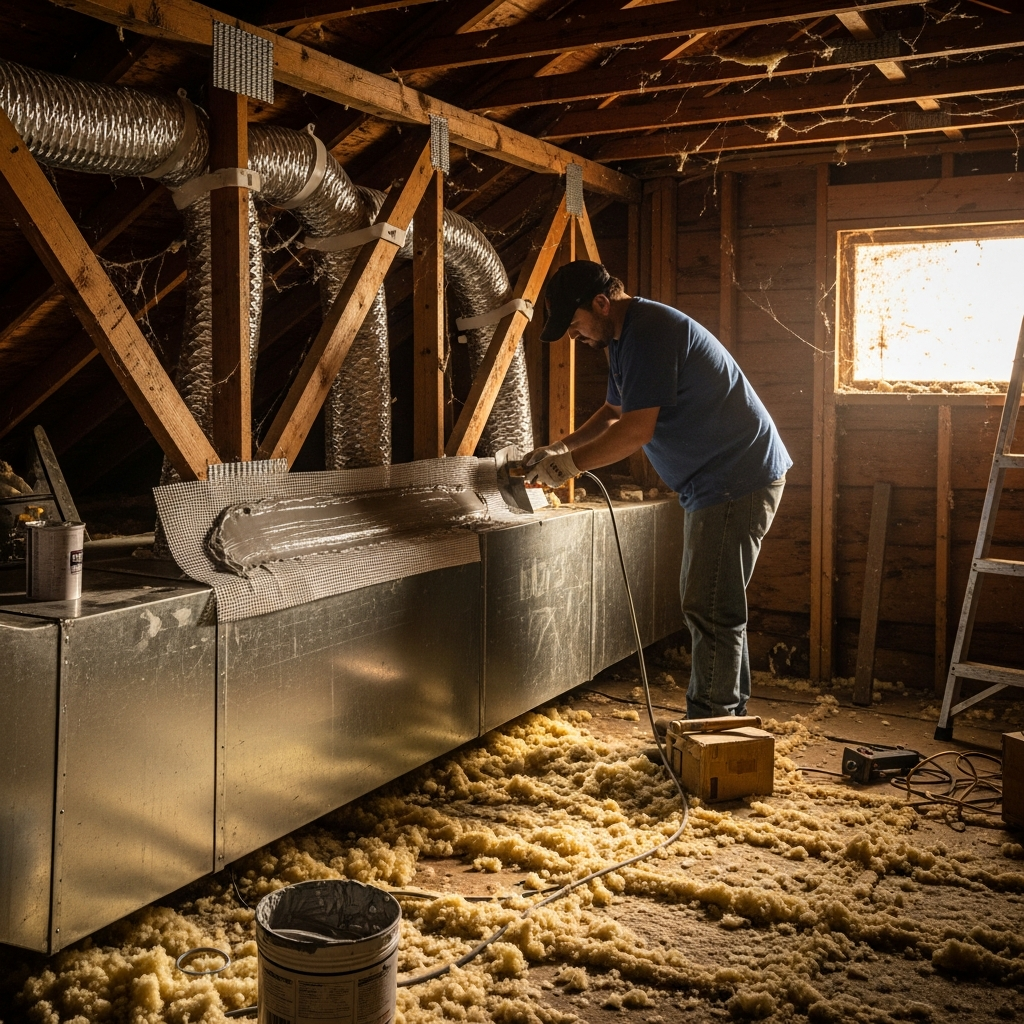
On the supply side, leaks and rough routes change how air feels at each register. We focus on collar connections at the plenum, takeoffs to branches, and boots at the ceiling or wall. Quality mastic, applied thickly and reinforced with mesh when needed, remains the standard for durable seals. We also look at the path itself: a flex duct making a sharp turn or pinched between framing members creates turbulence that encourages dust to stick, robs airflow, and produces unnecessary noise. By widening radii, adding supports to maintain shape, and trimming excess length that causes sags, we restore smooth, quiet delivery to every room.
Materials that stand the test of LA summers
There’s no substitute for materials that shrug off heat and dryness. We rely on UL-rated mastics designed for duct applications, compatible sealants for metal seams, and insulation jackets that keep their loft through August. Where flexible ducts tie into metal, we use proper bands and screws without over-penetrating the liner. For metal-only systems, we reinforce S-cleats and drive slips, then finish with a continuous seal along longitudinal joints. At boots and registers, we check for construction gaps around drywall or plaster that allow conditioned air to spill into cavities. A neat finish here isn’t about appearance alone—it preserves your hard-earned comfort.
Indoor air quality: the everyday win from tight ducts
When returns are sealed and supply runs are tight, your filter does its full job. That helps everyone, and especially those who feel seasonal irritants more acutely. Homes near busy corridors or in denser neighborhoods see particular benefits, as fewer particulates piggyback into the airstream. During late summer and early fall, when regional smoke or dryness tests indoor comfort, a sealed system maintains a calmer interior. You’ll notice less frequent dusting and a fresher, more neutral indoor scent, the kind of subtle improvement that makes a space feel restful.
Real-world examples from across the city
In a Los Feliz Spanish-style home, a return plenum had a narrow gap along one seam that only showed its hand under negative pressure. The fix—cleaning, reinforcing, and sealing—removed a faint musty note in the living room and brought a hint of quiet to the system’s startup. In a Valley ranch, two long branch runs were draped across wide spans, sagging at midpoints. By adding hangers at the right intervals and reshaping a tight bend into a broader curve, airflow evened out and a back bedroom finally matched the rest of the home. A Westside duplex presented the opposite issue: small leaks at multiple boots, each one minor on its own. Collectively, they bled enough air to keep the system working harder. Sealing those boots delivered a surprising, immediate sense of balance.
What to expect during a leak repair visit
We begin with a walkthrough to hear your story and to note when discomfort peaks—afternoons, late evenings, or during windy days. In the attic or crawlspace, we protect surfaces and work deliberately, photographing key findings so you can see exactly where air escaped and how we closed it up. Many repairs focus on sealing and support, which means careful, methodical work rather than heavy construction. When routes need modest reshaping, we coordinate to keep daily life flowing around us. By the time we’re done, you’ll have a clear sense of what was addressed and why it mattered for your comfort and indoor air.
Preventive habits that keep leaks at bay
After sealing, the maintenance routine becomes simple. Change filters on schedule and confirm they fit snugly without air bypassing the frame. Once or twice a year, take a moment to listen at startup; new rattles or changes in tone can hint at a support that loosened. A quick attic peek, if safe and accessible, can confirm that insulation jackets remain intact and that no other work in the space has pressed on ducts. These small habits catch issues early and protect the smooth, quiet performance you’ve regained.
When to combine leak repair with other improvements
If your home is mid-remodel or you’re adding a room, it can be wise to evaluate duct layout and sizing alongside leak sealing. Strategic changes ensure the new space integrates seamlessly and that return air remains adequate. Likewise, if you’re considering equipment upgrades down the line, sealing now lays the groundwork so any future system operates at its full potential. Think of tight ducts as the foundation—once sound, everything placed on top performs better.
Midway through many projects, homeowners ask whether a partial approach will suffice. Often the answer is yes, provided we address the return side thoroughly and the most impactful supply leaks. That’s also the point at which exploring skilled, local air duct repair guidance helps you prioritize with confidence, choosing the sequence of steps that fits your home and timeline.
Neighborhood nuances across LA
Climate and construction vary by block in this city. In the Valley, sustained attic heat challenges seals and insulation more than coastal zones do, so we pay extra attention to jackets and long runs. Near the ocean, salt air can encourage early corrosion at screws and seams, making routine checks prudent. In hillside homes with complex framing, we take special care to avoid sharp turns and to use hangers that hold form even when structures settle subtly over time. Each neighborhood brings its own rhythm, and a local approach means tuning repairs to match it.
FAQ: Clear answers for Los Angeles homeowners
How can I tell if duct leaks are the reason one room is always different? If a room lags especially during certain times of day, and if vents there seem quieter or sound harsher than others, leaks or constrictions on the supply route are likely. A quick diagnostic can confirm this.
Will sealing leaks help with dust inside the home? Yes. Tight ducts ensure air passes through the filter rather than sneaking in from attics or wall cavities, which reduces dust settling on surfaces.
Is the process disruptive? Most work happens in attics or crawlspaces. We protect living areas, keep the process tidy, and communicate throughout so daily routines stay intact.
How long do seals last? With quality materials and proper prep, seals handle Los Angeles summers for many years. Periodic visual checks during routine maintenance help confirm everything remains sound.
Do older homes require different techniques? Often, yes. Original framing, plaster ceilings, and limited access call for careful routing, gentle handling, and sealing methods that respect the structure while improving performance.
Will leak repair quiet my system? It frequently does. Sealing and smoothing routes reduce turbulence and rattles, replacing a sharp hiss or hum with a softer, steadier sound.
Is it worth addressing small leaks? Individually, tiny leaks seem minor, but together they can add up to a meaningful loss of performance. Sealing the set restores balance and supports indoor air quality.
Bring your home back into balance
If your Los Angeles home feels close to right but not quite there—if afternoons push a bedroom out of sync, if dusting happens more often than it should, if a faint draft notes its presence at a vent—it’s time to look closely at the paths your air takes. A focused visit can map the trouble, and careful sealing can return stillness and comfort to every room. When you’re ready for a steadier, quieter home, reach out for local expertise and proven air duct repair that treats your spaces with care and respect.