
Attic Insulation in Camarillo: R-Value Standards and Heat Block Strategies That Actually Work
Camarillo sits in a climate corridor that most insulation guides ignore. Marine layer mornings give way to dry, radiant afternoons that push attic temperatures well past what coastal homeowners expect. If your cooling bills climb every summer despite a seemingly modern HVAC system, the attic is almost always where the heat is winning. This guide breaks down what R-value actually means for Camarillo conditions, how to evaluate what you already have, and the practical strategies that keep heat out of your living space.
Why Camarillo’s Climate Creates Unique Insulation Demands
The Marine-to-Inland Temperature Swing
Camarillo occupies a transitional zone between the cooler Pacific influence near the coast and the hotter inland valleys of Ventura County. On a typical summer afternoon, outdoor temperatures may read a comfortable 80°F at street level while the unventilated attic above your ceiling bakes at 140°F or higher. That 60-degree differential is what insulation has to fight every single day from late May through October.
The problem compounds because Camarillo homes rarely see the prolonged overcast skies that keep true coastal cities cooler. The morning marine layer burns off by mid-morning, leaving rooftops exposed to direct solar radiation for the bulk of the day. A roof surface can absorb enough radiant energy to reach temperatures far above air temperature, and that heat conducts straight down into the attic cavity.
How Older Ventura County Homes Were Built
Much of Camarillo’s residential stock was built during rapid suburban expansion in the 1970s through the 1990s. Building codes at the time permitted insulation levels that would be considered inadequate by current California Energy Code standards. Many of those homes still have their original fiberglass batt insulation, which has settled, compressed, or absorbed moisture over decades, reducing its effective R-value significantly below the labeled rating on the bag.
Compression alone can cut a batt’s rated R-value by 20 to 40 percent. Add in gaps around recessed lights, attic hatches, and HVAC penetrations, and the real-world thermal resistance of an older attic assembly is often a fraction of what the original installation intended.
Radiant Heat vs. Conductive Heat: A Distinction That Matters Here
Standard insulation materials (fiberglass, cellulose, spray foam) resist conductive heat transfer, which is heat moving through solid material. But a significant portion of summer attic heat gain in sunny climates like Camarillo arrives as radiant energy, infrared radiation that travels through air before being absorbed by surfaces. Bulk insulation alone does not stop radiant heat. This is why radiant barriers and proper attic ventilation are not optional upgrades here; they are functional components of a complete heat block strategy.
R-Value 101: What the Numbers Mean for Your Attic
Reading the California Energy Code for Camarillo
California’s Title 24 energy standards place Camarillo in Climate Zone 6. For existing homes undergoing insulation upgrades, the current code calls for a minimum of R-38 in attic assemblies. New construction requirements are higher. If your attic currently has R-11 or R-19 batts from a 1980s build, you are well below the threshold that California considers the minimum for energy performance in this climate zone.
It is worth noting that code minimums are floors, not targets. Many energy consultants recommend R-49 or higher for Camarillo attics that see significant summer sun exposure, particularly on homes with low-slope rooflines or limited attic ventilation. Requirements and recommendations can shift as codes are updated, so it is always worth confirming current standards with a licensed contractor familiar with Ventura County permitting.
How to Estimate Your Current R-Value
You do not need sophisticated equipment for a rough assessment. A ruler and a flashlight will get you started.
- Fiberglass batts: Measure the thickness in inches. Standard unfaced batts deliver roughly R-3 to R-3.2 per inch. A 3.5-inch batt (designed for a 2×4 cavity) rates around R-11 when new and uncompressed.
- Blown cellulose: Approximately R-3.5 per inch when settled. A 12-inch depth would yield roughly R-42, though settling over time reduces depth and effective R-value.
- Blown fiberglass: Roughly R-2.5 per inch at settled density. A 15-inch depth reaches approximately R-38.
- Open-cell spray foam: Around R-3.7 per inch; closed-cell delivers approximately R-6.5 per inch.
Measure in several spots, not just one. Insulation depth varies significantly across an attic floor, particularly near eaves, around HVAC equipment, and at the attic hatch.
The Gap Problem: Where R-Value Calculations Break Down
Thermal bridging and air leakage gaps are where calculated R-value diverges most sharply from real-world performance. A single uninsulated attic hatch can account for a disproportionate share of total heat gain because heat follows the path of least resistance. Common gap locations in Camarillo homes include:
- Recessed can lights (especially older non-IC-rated fixtures)
- Top plates of interior walls where drywall meets the ceiling
- Plumbing and electrical penetrations
- HVAC supply and return boot connections at the ceiling plane
- Attic access hatches and pull-down stair assemblies
Air sealing these penetrations before adding insulation is not a bonus step. It is the step that determines whether the new insulation performs anywhere close to its rated value.
Insulation Types: Matching Material to Camarillo Conditions
Blown-In Cellulose and Fiberglass
Blown-in insulation is the most common upgrade path for existing Camarillo attics, and for good reason. It conforms around obstructions, fills irregular cavities, and can be installed to precise depth targets without cutting batts to fit. Cellulose, made primarily from recycled paper fiber, has a slightly higher R-value per inch than blown fiberglass and tends to perform better at blocking air movement within the insulation layer itself. Blown fiberglass settles less over time, which can help maintain depth and R-value over the long term.
Either material, installed to the correct depth with proper air sealing underneath, will deliver a meaningful improvement in a Camarillo home that currently sits below R-30.
Spray Foam for Specific Applications
Spray polyurethane foam is not typically the first choice for a full attic floor application due to cost, but it excels in specific situations. Sealing the rim joist area, encapsulating a conditioned attic assembly (where the roof deck rather than the floor is insulated), or filling irregular gaps around HVAC penetrations are all cases where spray foam’s combination of air-sealing and insulating properties makes it the right tool. In a conditioned attic design, closed-cell foam applied to the underside of the roof deck creates a sealed thermal envelope that keeps HVAC ducts inside conditioned space, which is a significant efficiency gain for homes with ductwork running through the attic.
Fiberglass Batts: When They Work and When They Don’t
Batts are appropriate for new construction where framing cavities are clean, accessible, and uniform. In existing Camarillo attics, they are harder to install correctly around existing insulation, obstructions, and irregular framing. They also leave gaps at edges and around penetrations unless supplemented with air sealing. If a contractor proposes batts as a retrofit solution for an attic floor that already has settled insulation, it is worth asking how they plan to address air sealing and edge gaps before accepting that approach.
Heat Block Strategies Beyond Insulation R-Value
Radiant Barriers and Their Role in Camarillo Attics
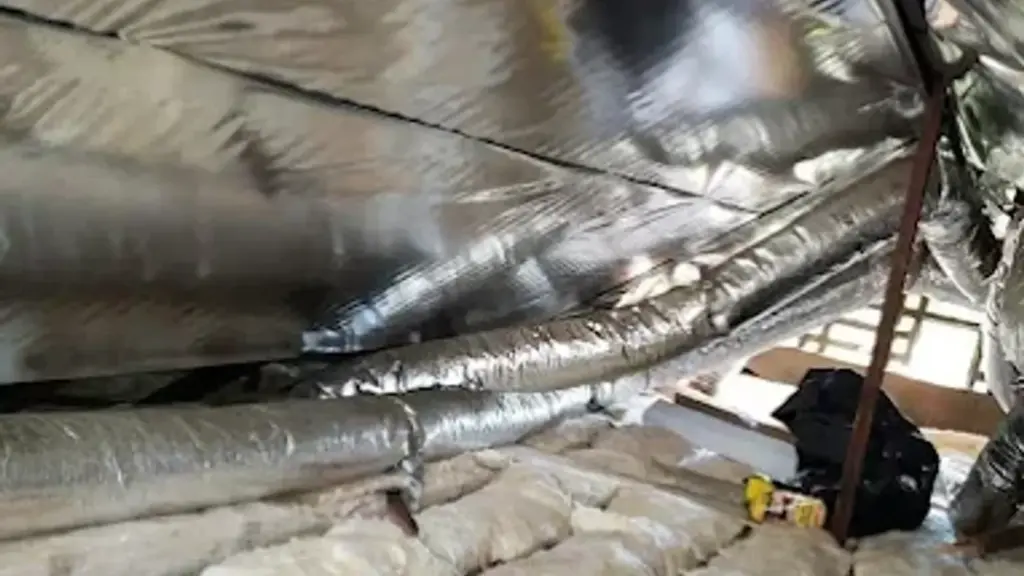
A radiant barrier is a reflective foil material, typically stapled to the underside of the roof rafters, that reflects infrared radiation back toward the roof before it can be absorbed by the attic floor insulation below. In climates with high solar intensity and significant cooling loads, radiant barriers can reduce attic air temperatures measurably, which reduces the temperature differential that bulk insulation has to manage.
The key installation detail is that the reflective surface must face an air gap to work. A radiant barrier installed directly against insulation or sheathing without an air space on at least one side loses most of its effectiveness. When correctly installed in a Camarillo attic, a radiant barrier works alongside bulk insulation rather than replacing it.
Attic Ventilation: The Forgotten Partner
Insulation and ventilation work as a system. Adequate ventilation allows hot air to exhaust from the attic space, reducing the temperature load that insulation has to resist. The standard ventilation guideline calls for 1 square foot of net free ventilation area for every 150 square feet of attic floor, split between low intake vents (at the soffits) and high exhaust vents (at the ridge or near the peak).
If you want it handled correctly the first time, consider professional insulation installation in Malibu, CA 90265 Los Angeles County.
Many Camarillo homes have blocked soffit vents from blown-in insulation that has drifted toward the eaves, or from pest screens that have become clogged over the years. Before adding more insulation, confirming that airflow can move freely from soffit to ridge is a basic check that significantly affects how well any insulation upgrade performs.
Duct Efficiency and Its Connection to Attic Performance
A well-insulated attic floor does less work if the HVAC ducts running through that same attic are leaking conditioned air into unconditioned space. Leaky supply ducts dump cooled air into the attic. Leaky return ducts pull hot attic air into the system. Both scenarios force the air conditioner to work harder and longer, which shows up on your utility bill regardless of how good the floor insulation is.
LA Attic Pro offers air duct repair and replacement services that address this problem directly. If your home in Camarillo has older flexible ductwork that has never been inspected, combining a duct assessment with an insulation upgrade is a logical sequence that maximizes the return on both investments.
Signs Your Camarillo Attic Insulation Is Underperforming
Temperature and Comfort Clues
Performance problems often show up in the living space before a homeowner thinks to look in the attic. Watch for:
- Rooms on the top floor that feel noticeably warmer than lower floors, especially in the afternoon
- An HVAC system that runs almost continuously on summer afternoons without reaching the thermostat setpoint
- Ceiling surfaces that feel warm to the touch in mid-afternoon
- Significant temperature variation between rooms on the same floor
Visual Inspection Red Flags
A quick look into the attic hatch can reveal a lot. Insulation that has yellowed, flattened, or shifted away from the eaves is not performing at its rated value. Visible gaps around recessed lights or where interior walls meet the ceiling plane are air leakage paths. Moisture staining on insulation or framing members suggests a ventilation or roofing issue that needs to be resolved before new insulation goes in.
Energy Bill Patterns
If cooling costs spike sharply in June and remain elevated through September, and the pattern has worsened over the past several years without a change in occupancy or thermostat habits, attic thermal performance is a reasonable suspect. An insulation contractor can take actual depth measurements and compare them to current standards to give you a concrete picture of where you stand.
What a Professional Insulation Assessment Covers
The Inspection Process
A thorough attic evaluation by a qualified contractor goes beyond measuring insulation depth. It includes checking ventilation airflow, identifying air leakage points, assessing the condition of existing insulation for moisture damage or pest contamination, and evaluating duct condition. In Camarillo, where rodent activity in attics is a recurring issue, an honest inspection will also flag any evidence of nesting or pest damage that would need to be addressed before new insulation is installed.
LA Attic Pro serves Camarillo and the broader Ventura County area and brings this full-system perspective to every evaluation. Rather than quoting insulation depth in isolation, a complete assessment gives you a prioritized picture of what matters most for your specific home.
Understanding the Upgrade Sequence
The order of operations matters. Air sealing comes before insulation. Pest remediation and sanitation come before insulation. Ventilation corrections come before insulation. Duct repairs, if needed, are most efficiently done while the attic is accessible during an insulation project. Skipping steps to reduce upfront scope typically means the new insulation underperforms and the homeowner returns sooner than expected for additional work.
Comparing Quotes Intelligently
When evaluating proposals from an attic insulation contractor in Camarillo, the most useful comparison points are not just the final number but what the scope includes. A proposal that specifies the target R-value, the material and its settled R-value per inch, the air sealing locations to be addressed, and the ventilation check is a more reliable document than one that simply states a square footage and a material type. Ask whether the quote includes removing existing insulation if it is damaged, and whether the crew will install baffles at the eave vents to maintain airflow after blown-in material is added.
R-Value Comparison: Common Insulation Options for Camarillo Attics
| Material | Approx. R-Value per Inch | Best Application | Key Consideration |
|---|---|---|---|
| Blown Fiberglass | R-2.5 (settled) | Attic floor retrofit | Settles less than cellulose over time |
| Blown Cellulose | R-3.5 (settled) | Attic floor retrofit | Higher R per inch; good air resistance within layer |
| Open-Cell Spray Foam | R-3.7 | Conditioned attic, air sealing | Vapor permeable; requires careful moisture analysis |
| Closed-Cell Spray Foam | R-6.5 | Roof deck, rim joists, tight spaces | Highest R per inch; also acts as vapor barrier |
| Fiberglass Batts | R-3.0 to R-3.2 (uncompressed) | New construction framing cavities | Performance drops significantly if compressed or improperly fitted |
Frequently Asked Questions
What R-value should I target for my Camarillo attic?
California’s Title 24 code sets R-38 as the minimum for attic upgrades in Climate Zone 6, which covers Camarillo. Many contractors recommend R-49 for homes with significant sun exposure or limited ventilation, as code minimums are starting points rather than performance targets. Confirm current requirements with a licensed contractor familiar with Ventura County standards.
How do I know if my existing insulation needs to be removed before adding more?
Removal is typically necessary when existing insulation shows moisture damage, mold, or pest contamination. Settling and compression alone do not always require removal; in many cases, blown-in material can be added on top of existing batts after air sealing is complete. A professional inspection will determine which approach is appropriate for your specific attic condition.
Does a radiant barrier replace the need for bulk insulation?
No. A radiant barrier addresses radiant heat gain, while bulk insulation (fiberglass, cellulose, foam) addresses conductive heat transfer. Both mechanisms contribute to summer heat gain in Camarillo attics, so the two strategies complement each other rather than substitute for one another. A radiant barrier without adequate bulk insulation will not meet code requirements.
How long does an attic insulation installation typically take?
For a standard single-story Camarillo home with a straightforward attic layout, a blown-in insulation installation including air sealing typically takes one day. Larger homes, conditioned attic assemblies involving spray foam, or projects that include insulation removal and pest remediation will take longer. Your contractor should provide a realistic timeline based on the specific scope before work begins.
Will adding attic insulation affect my HVAC system sizing?
A significant improvement in attic thermal performance can reduce the cooling load on your HVAC system, which is a positive outcome. It does not typically require resizing existing equipment, though if your system was already undersized for the original heat load, improved insulation may simply allow it to keep up more easily. Consult your HVAC technician if you have concerns about system performance after an insulation upgrade.
Does attic insulation work the same way in winter for Camarillo homes?
Yes, though the direction of heat flow reverses. In winter, insulation slows heat loss from the conditioned living space up through the ceiling into the cold attic. Camarillo winters are mild compared to inland California, but heating costs are still real, and properly insulated attics help maintain comfortable temperatures with less furnace run time.
Conclusion
Camarillo’s climate puts real demands on attic insulation that generic guides written for colder or more humid regions simply do not address. Getting the R-value right for your specific home, pairing it with air sealing, ventilation, and a radiant barrier where appropriate, and making sure existing ductwork is not undermining the whole effort, that is the complete picture. If you are ready to find out exactly where your attic stands, schedule an attic insulation assessment with LA Attic Pro and get a clear, honest evaluation of what your Camarillo home actually needs.