
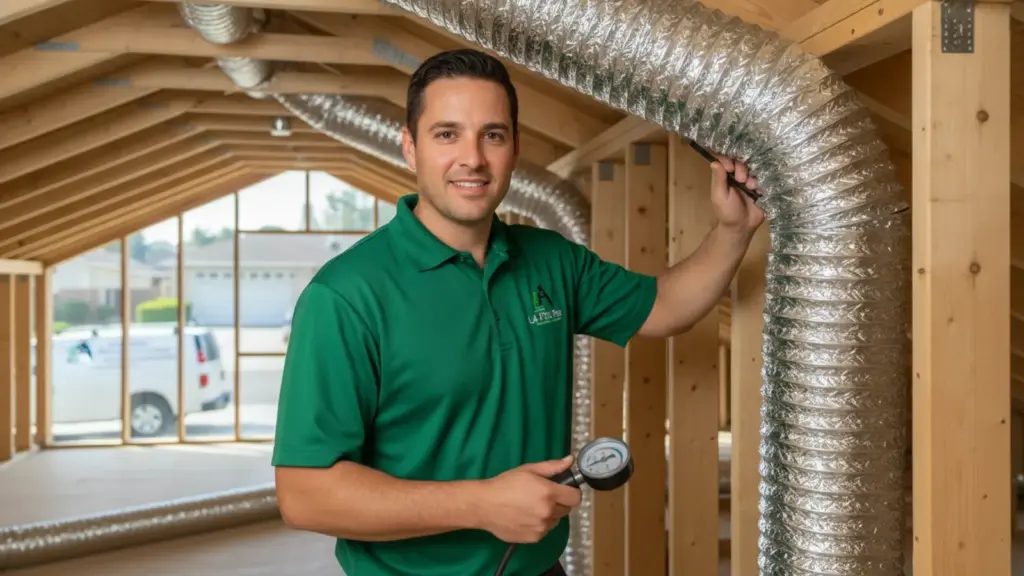
Evaluating Attic Duct Replacement in Los Angeles: How Sealed Attic Ducts Protect Your New Insulation Investment
Los Angeles homeowners invest heavily in climate control to combat blazing summer heatwaves and chilly winter evenings. When energy bills climb, the immediate instinct is to look at upgrading the attic insulation. While laying down fresh fiberglass or blown-in cellulose is a highly effective way to stabilize indoor temperatures, doing so over a failing, leaky duct network is a costly mistake. If your delivery system is broken, your thermal barrier cannot do its job properly. Understanding how attic duct replacement works alongside a comprehensive insulation upgrade is the key to maximizing your home comfort and protecting your hard-earned financial investment.
The Hidden Conflict Between Leaky Air Ducts and Fresh Attic Insulation
How Air Duct Leaks Actively Degrade New Insulation Materials
When we install fresh, high-quality material during a professional attic insulation installation, we create a continuous thermal blanket over your ceiling. However, if your underlying ductwork has unsealed joints, tears, or degraded seams, pressurized conditioned air escapes directly into the attic floor. This localized airflow does more than waste your cooled air; it physically disrupts loose-fill insulation, pushing it away from the drywall and creating cold spots. Over time, the moisture carried by warm, humid indoor air can deposit onto cold duct surfaces or get trapped within the surrounding insulation, leading to localized compaction and a severe reduction in R-value.
The Physics of Convective Loops in the Attic Space
An attic is a dynamic environment governed by temperature and pressure differentials. When old, damaged ducts leak cool air into a hot attic during a Los Angeles summer, they create artificial convective loops. The escaping cold air sinks, while hot attic air rises and circulates rapidly. This constant air movement accelerates heat transfer across your ceiling, forcing your HVAC system to work overtime. By bypassing your new insulation entirely, these air leaks neutralize the very barrier you paid to establish, rendering your energy-saving efforts far less effective.
Compromising Indoor Air Quality and Cleanliness
Air ducts do not just leak air out; when the system cycles off, they can pull dusty, unconditioned attic air in through depressurized joints. If you have recently upgraded your space with an attic insulation service, the tiny fibers and dust particles from the installation can be drawn directly into your ductwork through these gaps. Once inside, your HVAC blower distributes these particles throughout your living spaces, causing dusty surfaces and lower indoor air quality. Sealing or replacing these conduits ensures that your living space remains isolated from the harsh environment of the attic floor.
Why Many Los Angeles Homeowners Overlook the Ducts During Insulation Upgrades
The “Out of Sight, Out of Mind” Attic Reality
For most residents in Los Angeles, CA, the attic is an unvisited, dark space used only for occasional storage. Homeowners naturally focus on visible upgrades like double-pane windows or smart thermostats while ignoring the structural elements hidden beneath layers of dust. It is common to assume that because a furnace or air conditioner is relatively new, the distribution system carrying the air is in perfect health. Unfortunately, standard flexible ducting has a shorter lifespan than the heavy sheet metal ducts of the past, often degrading silently over fifteen to twenty years.
The Illusion of the Thermal Barrier
There is a common misconception that simply piling more insulation over existing ducts will solve your energy loss problems. Some believe that burying old, leaky ducts in deep blown-in insulation acts as a natural seal. In reality, loose-fill fiberglass or cellulose is porous and does not stop air movement. Conditioned air easily pushes through the loose fibers, escaping into the attic while creating pathways for dust and debris to return back down through your register vents.
Misunderstanding the True Source of High Utility Bills
When cooling costs soar during a scorching valley summer, it is easy to blame a lack of insulation or an old air conditioning unit. However, studies by energy organizations show that typical duct systems lose up to thirty percent of their conditioned air to unconditioned spaces like attics and crawl spaces. Without a thorough inspection, homeowners risk paying for a high-end insulation job while leaving the primary driver of their high energy bills completely untouched.
The Core Signs Your Home Needs an Attic Duct Replacement
Visible Material Degradation and Deteriorating Outer Wraps
If you venture into your attic space with a flashlight, the physical condition of the ducts is often highly telling. Older homes in Los Angeles frequently feature grey plastic flexible ducts. Over decades of exposure to extreme attic heat, this outer plastic lining becomes brittle, cracks, and flakes away, exposing the fiberglass insulation underneath. Once this outer vapor barrier is compromised, the duct loses its thermal resistance, and air easily leaks through the inner core fabric.
Uneven Temperatures and Sluggish Airflow Across Rooms
Are certain bedrooms in your house consistently warmer or cooler than the rest of the home? If some supply registers barely whisper with airflow while others blow strongly, you are likely dealing with kinked, disconnected, or crushed ductwork. In many tight Los Angeles attics, ducts are routed over ceiling joists or squeezed under low rooflines, making them highly susceptible to crushing from cable installers, plumbers, or previous home repair work.
Persistent Dust Accumulation Near Supply Registers
If you notice dark rings of dust forming around your ceiling vents or find yourself dusting your furniture constantly despite regular filter changes, your ducts are pulling in dirty air from the attic. This typically happens at the connections where the flexible duct meets the metallic register boot. Over time, the tape or mastic sealant dries out, cracks, and fails, leaving a direct pathway for raw attic air and fine debris to enter your home’s air stream.
Comparing Partial Repairs with Full Duct Replacement
Evaluating the Long-Term Economics of Air Duct Upgrades
While minor joint separations can sometimes be sealed with high-quality mastic paste and foil tape, older systems with widespread material failure require a complete overhaul. Attempting to patch dry-rotted flexible ducts is a temporary fix that often costs more in repeated service calls than a clean start. Investing in a comprehensive air duct replacement guarantees that every foot of your air distribution system is airtight, properly insulated, and designed for optimal airflow dynamics.
To help you decide which path makes the most sense for your home, review this comparison of standard repairs versus a complete system replacement:
| Factors to Consider | Local Air Duct Repair & Sealing | Complete Attic Duct Replacement |
|---|---|---|
| Primary Use Case | Minor joint leaks, disconnected runs, or localized physical tears on relatively new ducts. | Widespread dry rot, crushed lines, mold growth, heavy rodent damage, or old R-4.2 insulation. |
| Thermal Efficiency | Maintains existing R-value; only stops active air leakage at the specific repair points. | Upgrades the entire system to modern R-6 or R-8 insulation standards, cutting thermal loss. |
| System Longevity | Short-term extension (typically 3 to 5 years) on aging materials before new leaks develop. | Long-term reliability (15 to 25 years) with modern, puncture-resistant materials and secure hangers. |
| Impact on Airflow | Addresses local flow issues but cannot fix structural design flaws or undersized runs. | Restores balanced static pressure, optimizes duct routing, and maximizes air delivery to all rooms. |
Addressing Rodent Contamination and Biological Hazards
One of the most compelling reasons to opt for a replacement over a repair in Southern California is rodent damage. Mice and rats find the warmth of attic spaces highly appealing, often nesting inside the fiberglass wrap of flexible ducts or chewing directly through the plastic inner lining to travel through your heating system. Once animals have colonized your ductwork, they leave behind droppings, urine, and nesting debris. Sealing these holes is not enough to address the biohazards inside. A clean replacement removes these contaminated materials entirely, ensuring your home’s air is not circulating over biological waste.
Optimizing System Sizing and Static Pressure
Older HVAC systems were often installed with “rule of thumb” duct sizing that does not match modern airflow standards. When we perform a complete attic duct replacement, we do not just swap old materials for new ones. We recalculate the airflow requirements of each room based on square footage, window placement, and system capacity. Properly sized ducts reduce static pressure, allowing your furnace and air conditioning unit to run quieter, distribute air more evenly, and consume less electricity.
The Strategic Benefits of Coordinating Duct Replacement with Insulation Services
The Practical Advantages of a Clean Slate
Trying to replace your air ducts after laying down thick layers of fresh, loose-fill attic insulation is incredibly difficult and messy. Technicians must wade through foot-deep insulation, which inevitably displaces the material, ruins the uniform depth, and can contaminate the duct joints during the assembly process. Coordinating these services means the old, dirty insulation is removed first, the attic space is thoroughly cleaned and sanitized, the new ducts are installed and tested, and then the fresh insulation is laid down cleanly over an airtight foundation.
Maximizing Your Total Return on Investment
By scheduling your ductwork and insulation services together, you eliminate redundant labor and maximize your energy savings from day one. Your HVAC system will no longer have to work at maximum capacity to compensate for escaping air, significantly reducing wear and tear on your expensive compressor and blower motor. Combining these services ensures that every dollar you invest in high-R-value materials is fully protected by a closed-loop, highly efficient air delivery system.
Achieving Consistent Comfort Throughout Your Home
When you have a fully sealed, modern duct system insulated to current standards resting beneath a fresh, deep layer of high-performance attic insulation, your home’s thermal performance dramatically improves. You will notice that indoor temperatures remain stable long after your HVAC system turns off. Rooms that used to feel like ovens in the summer or iceboxes in the winter will finally maintain a comfortable, balanced climate year-round.
Our Step-by-Step Approach to Attic Duct and Insulation Upgrades in Los Angeles
1. Thorough Attic Assessment and Diagnostic Testing
Our process begins with a comprehensive inspection of your existing attic environment. We map out the routing of your current ductwork, looking for signs of animal intrusion, disconnected joints, crushed runs, and localized insulation settling. Our team uses specialized tools to evaluate air leaks and inspect the condition of your home’s thermal envelope, giving us a clear picture of exactly where your conditioned air is escaping.
2. Safe Removal and Environmental Sanitation
If we find contaminated insulation or degraded ductwork, we utilize high-powered, truck-mounted vacuums to safely extract all old fiberglass, cellulose, and pest debris from your attic. This step is critical to prevent airborne contaminants from entering your living spaces. Once the attic floor is completely bare, we perform a deep sanitation process, neutralising odors and eliminating biological traces left behind by pests.
3. Precision Duct Design and Airtight Installation
With a clean attic space, our technicians install your new, high-efficiency duct system. We use durable materials insulated to modern energy code requirements (typically R-6 or R-8). Every connection point is mechanically fastened, sealed with professional-grade mastic paste, and wrapped securely to prevent any future air leakage. We suspend the flexible ducts off the attic floor using wide webbing straps to maintain straight, unkinked runs and prevent crushing.
4. Air Sealing and Final Insulation Placement
Before the new insulation is installed, we perform meticulous air sealing across your attic floor, closing up the gaps around electrical wires, plumbing pipes, and light fixtures. Finally, we perform your fresh attic insulation los angeles installation, blowing in or laying down high-quality material to the precise depth needed to achieve your desired thermal barrier. This comprehensive approach ensures that your home is fully protected from both conductive heat transfer and convective air loss.
Frequently Asked Questions
How long does an attic duct replacement typically take?
For a standard single-family home in the Los Angeles area, a complete duct replacement usually takes one to two days. If you are combining the project with insulation removal and reinstallation, the entire process is generally completed within two to three working days, keeping your home’s downtime to a minimum.
Will new attic insulation fix hot and cold spots in my house?
While fresh insulation helps slow down heat transfer through your ceiling, it cannot fix uneven temperatures caused by leaking or poorly sized ductwork. If your conditioned air is escaping through broken duct joints before it ever reaches your rooms, replacing those failing ducts is necessary to achieve balanced comfort.
How often should attic air ducts be replaced?
In most residential homes, flexible ductwork has a practical lifespan of roughly fifteen to twenty years. Over this period, the plastic liners, tape adhesives, and outer insulation jackets slowly break down due to extreme temperature swings in the attic, leading to air leaks and poor HVAC efficiency.
Can I just seal my existing ducts instead of replacing them?
If your ducts are relatively new, structurally sound, and free of biological contamination, localized sealing is a great option. However, if the duct system is old, brittle, damaged by pests, or insulated with outdated materials, a full replacement is the only way to ensure reliable, long-term performance.
Protect Your Los Angeles Home with Professional Attic Services
Investing in your home’s thermal comfort is one of the smartest decisions you can make to lower your utility bills and improve your daily quality of life. Do not let old, leaky ductwork undermine the performance of your brand-new attic insulation. LA Attic Pro is here to ensure your air delivery system and thermal barrier work in perfect harmony to keep your home comfortable in any season. Contact our experienced local team today to schedule your attic duct replacement and insulation consultation.