
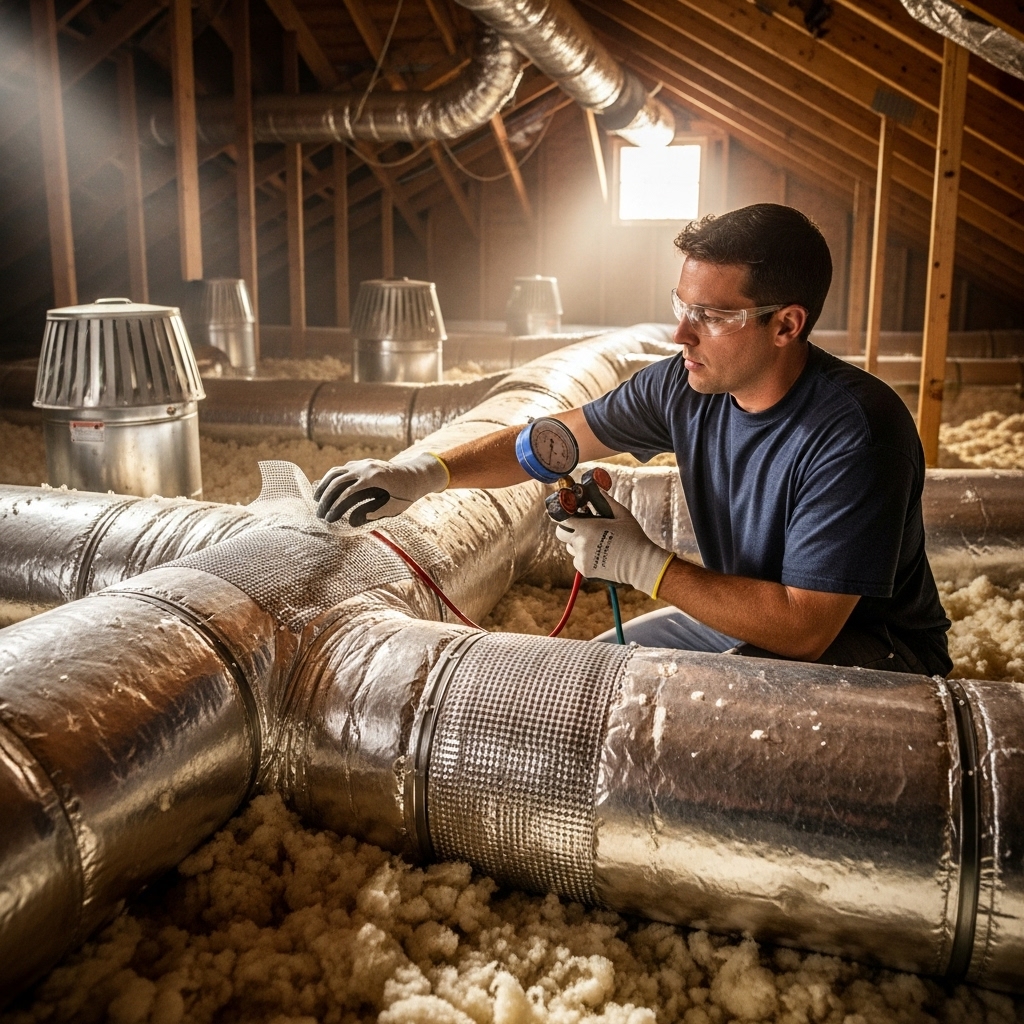
Why sealing duct leaks matters in Los Angeles
Energy savings in Los Angeles is not only about new equipment or smart thermostats. Much of what determines how efficiently your home runs is hidden behind drywall and above your head in the attic. Duct leakage—air escaping through seams, unsealed joints, or tiny holes—silently erodes performance every hour your system runs. Because our climate invites nearly year-round operation, losses add up quickly. When warm attic air is pulled into a return or conditioned air spills into the attic, your system must work longer to reach the same setpoint, consuming more energy than necessary. Addressing those leaks through a careful repair process offers one of the most reliable paths to comfort and efficiency gains in Los Angeles homes.
Residents often ask how duct leakage gets started in the first place. It is rarely one big failure and more often countless small ones that accumulate with time. Seams that were never sealed properly during construction, flex runs pulled taut and left without adequate support, boots to drywall connections that shift as houses settle—all of these provide paths for air to escape. Add the expansion and contraction that come with warm days and cool nights, plus the occasional service work that bumps against the ducts, and you have a recipe for leakage that only worsens without intervention.
The advantage we have in Los Angeles is experience. Local technicians who spend their weeks in our attics, basements, and crawlspaces know how to spot typical failure points quickly. They also understand how different neighborhoods influence duct performance. A modest bungalow in Mar Vista may have ducts running close to the roof deck with little room to maneuver, while a Sherman Oaks ranch could have long trunk lines feeding distant bedrooms. Leakage shows up in different ways across these layouts, and repair strategies must adapt to each home’s architecture.
Before any sealant touches a seam, a good process starts with evaluation. This can include visual inspection, smoke puffs near suspected leaks, and pressure measurements that reveal how air moves through the system. Some homes benefit from a duct pressurization test, which helps quantify the total leakage and provides a baseline. But the real power of this evaluation is how it informs the onsite plan: where to focus first, which materials to use, and how to ensure new seals last under our regional climate conditions.
Sealing itself is both craft and science. Technicians clean the surfaces, remove old tape that has dried out or delaminated, and use mastic or compatible sealants applied in a consistent, continuous layer. For gaps that span larger joints, reinforcing mesh bedded in sealant creates a flexible but durable barrier. Rigid metal duct transitions receive attention at the seams and at the slips and drives, while flex-to-metal connections are re-secured with collars and tightened straps. In many Los Angeles attics, sealing is paired with improving supports so flex duct holds its shape and does not sag, keeping friction low and airflow steady.
Energy savings from these steps feel especially tangible in our climate zones. On a summer afternoon in the Valley, attic temperatures can climb sharply. Any leak that allows cold, conditioned air to spill into that environment is like opening a window and letting comfort drift away. In winter, even mild as it is, leaks can chill supply runs so that air arrives cooler than intended, prompting longer system runtimes. By closing those paths, your home maintains target temperatures with fewer cycles, which reduces wear and smooths out the indoor experience.
What about returns? They deserve equal attention. A leaky return is like leaving a vacuum cleaner hose in a dusty attic; it pulls in particles and hot air that never passed through a filter, then pushes that mixture into the living spaces. Sealing returns, ensuring tight filter housings, and confirming that the return pathway is generous enough for your system’s airflow needs combine to produce cleaner, quieter operation. For allergy-sensitive households, this can deliver a noticeable relief, especially during high pollen months and dry Santa Ana conditions.
Homeowners often wonder what the day of repair feels like. In most cases, technicians will protect flooring, bring in lighting for attic work, and methodically move through the system from the air handler outward. They may pause to take interim readings, comparing before-and-after pressures to verify progress. Communication remains central: knowing why a particular seam matters or how a specific repair will change airflow helps you understand the value of the work.
At this point, it is useful to connect the idea of sealing with the broader system. Ductwork does not exist in isolation. It interacts with registers, the air handler, the thermostat strategy, and the building envelope. Sometimes, while addressing leaks, a conversation arises about balancing airflow to rooms that have changed use—a home office that now runs computers all day, or a nursery that needs calmer, gentler flow. This holistic thinking turns a repair into an upgrade that shapes how your home feels across seasons.
For anyone comparing bids or deciding whether to move forward, education is empowering. Understanding what thorough air duct repair includes—cleaning and preparation, proper sealants, reinforced joints, attention to returns, tested improvements—helps you ask the right questions and avoid quick fixes that do not last. Good providers in Los Angeles do not treat sealing as a dab here and a strip there; they approach it as a system-wide effort that respects how your particular home is built.
Post-repair, the benefits extend beyond energy savings. You may notice a steadier, quieter system, with fewer hot and cold spots and less dust accumulating on surfaces. Filters tend to do their jobs more effectively when returns are sealed, which can lengthen filter life between changes. The air handler may start and stop more gracefully, and you might find that thermostat changes register more quickly because the air you pay to heat or cool is actually reaching the rooms.
Maintenance keeps those gains in place. A brief attic check after the first heat wave of summer and again after the first cool snap of winter helps ensure supports hold and cured mastic remains intact. If a home improvement project jostles a portion of the duct system, revisiting seals and supports afterward is wise. Over time, this vigilance preserves the efficiency you earned on repair day.
The Los Angeles landscape also brings unique external stresses. Wildlife sometimes disturbs insulation, and in a few neighborhoods, construction vibrations from nearby projects can nudge joints. Wind-driven dust during dry weeks can infiltrate attics, making return leaks more consequential. A local team knows to look for these patterns and can recommend simple protective steps, from better access platforms to minor rerouting that reduces vulnerability in tight spots.
Frequently asked questions
Q: How much leakage is typical in older Los Angeles homes? A: It varies widely. Age, prior work quality, and layout all influence leakage levels. What matters most is finding and sealing the significant paths, then verifying improvements with measurements.
Q: Can sealing ducts change how loud my system sounds? A: Yes. Eliminating leaks can reduce hiss and whistling. Proper supports and smoother airflow also lower turbulence, often making operation feel calmer.
Q: Will sealing help rooms at the end of long runs? A: It often does. When the whole system is tighter, more of the air your system produces actually reaches distant rooms. In some cases, minor balancing or register upgrades complement the sealing work for even better results.
Q: Is it necessary to seal both supply and return ducts? A: Addressing both is best. Supply leaks waste conditioned air, while return leaks can pull in dust and hot or cold attic air. Sealing both sides protects comfort and indoor air quality.
Q: How do I maintain the results? A: Keep filters changed on schedule, ensure access to attic pathways remains clear, and consider seasonal quick inspections to confirm that supports, insulation, and seals remain sound.
Q: What should I ask a contractor before approving the work? A: Ask about their evaluation method, the materials they will use, how they prepare surfaces, where they anticipate the biggest issues, and how they will verify results when the job is complete.
Start saving energy with expert help
If you suspect your system is running longer than it should or you notice dust around registers or inconsistent room temperatures, now is the time to act. A thoughtful sealing and repair plan can transform how efficiently your home performs and how comfortable it feels. Connect with a trusted local team for professional air duct repair and discover how much more your current system can deliver once the leaks are gone.