
When you invite a contractor into your home to work above the ceiling or beneath the floor, you’re trusting them with the air your family breathes every day. In Los Angeles, that trust begins with licensing, safety practices, and a service approach that treats your home with the respect it deserves. As someone who has walked countless attics from Mar Vista to Pasadena, I’ve seen how the right team transforms a complicated project into a calm, well‑managed experience. If you’re researching air duct replacement, here’s how licensed services make the process safer, cleaner, and more successful from start to finish.
What licensing means for duct work in California
In California, warm‑air heating, ventilation, and air conditioning work is typically performed by contractors holding a C‑20 license, which verifies experience and testing in the mechanical trades. Depending on specific scope, some insulation‑focused tasks may involve other classifications, but the heart of duct replacement—designing, installing, sealing, and verifying a forced‑air distribution system—sits squarely within the HVAC specialty. A licensed contractor not only understands how to move air; they also understand code requirements, permitting, and the commissioning steps needed to demonstrate that the finished system performs as intended.
Permits, Title 24, and third‑party verification
Permits protect homeowners and ensure that projects meet the state’s energy and safety standards. In Los Angeles, Title 24 requires verification by certified raters who test duct leakage and confirm that work meets current performance requirements. A licensed service coordinates the paperwork, schedules inspections, and welcomes the oversight because it validates their craftsmanship. The end result is a documented record you can keep with your home files.
Design first, then installation
Licensed services lead with design. They begin by assessing your system’s current static pressure, measuring registers, noting equivalent lengths for fittings, and evaluating the return pathway. If there are comfort complaints—a warm back bedroom, a noisy living room grille, or a home office that never quite feels right—those concerns guide the redesign. A plan that respects friction rate, balances branch lengths, and matches airflow to room needs sets the stage for a quiet system that delivers even temperatures.
Material choices and craftsmanship
Quality shows in the details: mastic at every joint, properly sized collars, hangers that support ducts without crushing insulation, and insulation levels appropriate for our climate. Many Los Angeles homes benefit from rigid trunks in key sections, with supported flex for branches where access is tight. The best teams combine both, using smooth transitions to reduce turbulence and keeping bends as generous as space allows. Every decision—from boot selection to diffuser orientation—aims at stable airflow and low noise.
Clean, safe work practices
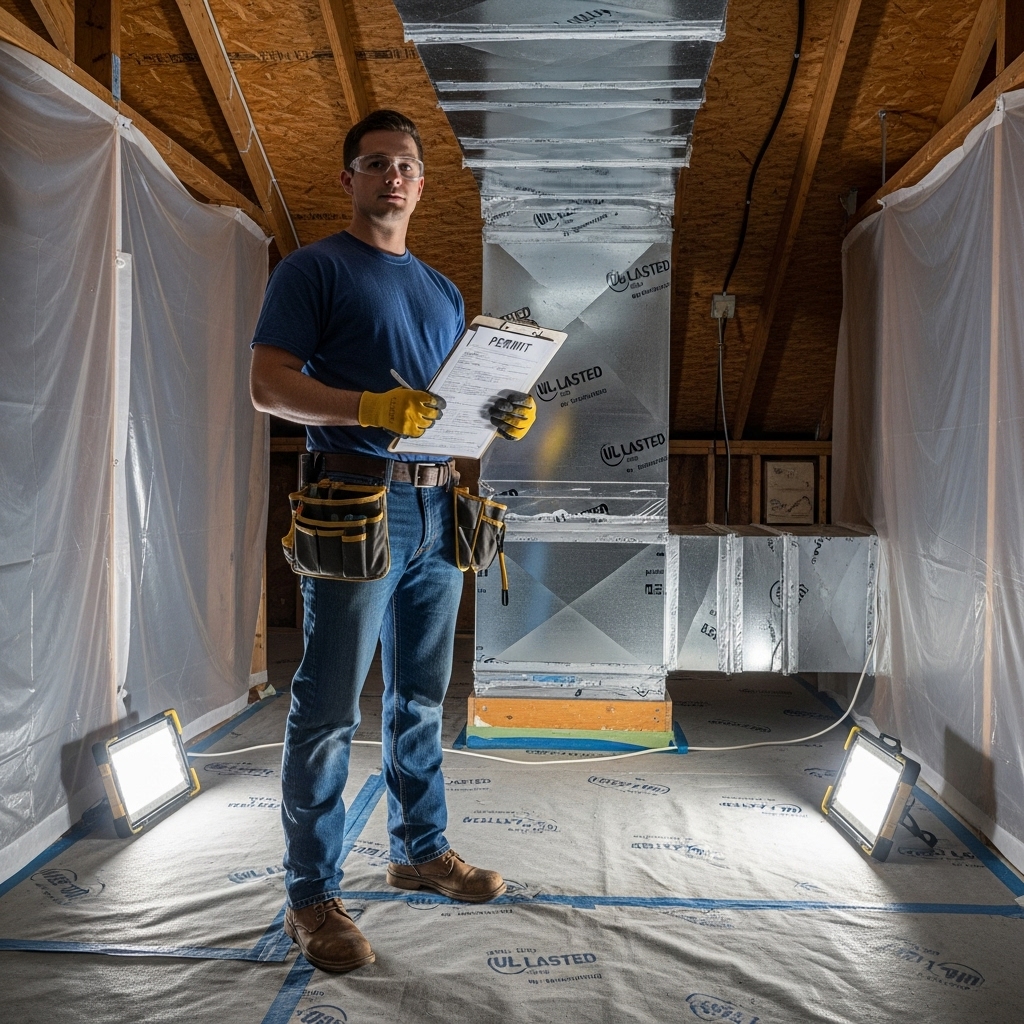
A licensed provider arrives with a plan to protect your home. Floor coverings go down, access points are sealed off, and daily clean‑ups are part of the routine. If attic insulation is disturbed, it’s contained and restored. Crews know how to stage materials, navigate tight parking, and coordinate with HOAs when necessary. In a city where pets are family, clear communication about gates and doors is part of the protocol. When safety concerns arise—suspected asbestos on old duct wraps or signs of contamination—licensed professionals follow proper procedures and coordinate qualified testing or remediation before proceeding.
Communication that keeps you in the loop
From the first walkthrough to the final test, you should know what’s happening and why. Licensed services provide a written scope that explains the design intent, shows where new trunks and branches will run, and notes any upgrades to returns or registers. During the job, mid‑day updates and photos help you track progress. At the end, testing results and a simple orientation show you how to change filters, set dampers if present, and get the most from your system.
Balancing and testing for real‑world comfort
The best proof of quality is how the home feels. Balancing dampers, if used, are set based on measurements rather than gut feel. Static pressure is checked to make sure the blower isn’t strained. Duct leakage is tested and documented. These steps take time, but they pay you back every day in quieter operation and rooms that feel more alike from one end of the house to the other.
Los Angeles‑specific considerations
Our city’s variety of housing stock invites unique strategies. Tightly packed bungalows with low attics call for careful routing and secure supports. Contemporary homes with vaulted ceilings demand creative solutions to maintain insulation continuity. Hillside properties often require thoughtful access plans to move materials and debris safely. Coastal homes benefit from corrosion‑aware hardware choices. And across the region, wildfire season puts a premium on airtight returns and effective filtration strategies that don’t overload the blower.
What to expect from a professional visit
Expect questions. A licensed specialist will ask how your home behaves on hot afternoons, whether certain rooms get stuffy, and if noise at specific registers bothers you. They’ll measure, photograph, and sketch. They will point out opportunities—perhaps an undersized return or a long, kinked branch starving a back bedroom—and explain how the new design fixes them. A thoughtful conversation leads to a scope tailored to your home and goals, rather than a one‑size‑fits‑all recipe.
Choosing between proposals
When you compare proposals, look for clarity and completeness. Does the scope describe demolition and disposal, new layout and supports, sealing and insulation, return improvements, and verification? Does it address comfort complaints you mentioned? Are there notes about register sizing or diffuser style where appropriate? A proposal that anticipates details shows that the team will do the same once the attic hatch is open.
Mid‑project walkthroughs
Some of the best conversations happen when ducts are hung but not yet insulated. You can see the main trunks, check support spacing, and understand how branches serve each room. This is a great time to confirm that design intent is being followed and to ask about balancing strategies or static pressure targets. If you’re still browsing services that specialize in air duct replacement, use what you learn during a walkthrough to ask sharper questions and get clearer commitments.
Life after installation
Once the work is complete and tested, you should notice the difference right away: more even temperatures, less register noise, and a system that doesn’t feel like it’s straining. Keep a copy of the test results, permit records, and scope documents with your home files. A quick seasonal check—changing filters, confirming that supply diffusers haven’t been accidentally closed, and keeping the return clear—helps preserve the gains your new ducts deliver.
FAQ
Why is licensing important for duct replacement?
Licensing confirms that the contractor has documented experience, passed state exams, and carries the protections that come with doing business legitimately. It also signals familiarity with code, permitting, and the testing that accompanies modern duct work.
Do licensed services handle permits and inspections?
Yes. Reputable providers manage permits, schedule inspections, and coordinate third‑party testing. This ensures your project is aligned with local requirements and that performance is verified, not assumed.
Will a licensed contractor help with design or just installation?
The best licensed contractors design first. They evaluate airflow needs, return capacity, and equivalent lengths to produce a layout that serves your home quietly and efficiently.
Can I stay in the home during the project?
Most homeowners do. Licensed crews protect floors and furnishings, contain dust, and keep pathways clear. They coordinate schedules and manage noise so that life can continue with minimal disruption.
What happens if the crew finds a safety concern?
Licensed professionals follow protocol: they pause work, explain the concern, and bring in qualified testing or remediation if needed. Safety comes first, and clear communication keeps you informed at every step.
How will I know the new ducts are performing well?
Performance is confirmed with duct leakage tests, static pressure measurements, and a comfort check in the home’s farthest rooms. You’ll receive documentation to keep with your records.
Ready to work with a licensed local expert?
If you want a team that treats design, safety, and verification as non‑negotiables, reach out to a provider that specializes in air duct replacement for Los Angeles homes. With careful planning, clean execution, and clear communication, you’ll feel the difference every time you take a deep, comfortable breath at home.