
Questions to Ask a Camarillo Insulation Contractor Before You Hire
Old or contaminated attic insulation left in place doesn’t stay quiet. It slowly degrades your home’s thermal envelope, can harbor moisture, and may conceal evidence of rodent activity or decades of accumulated debris. For Camarillo homeowners, the decision to hire someone to remove and replace it often happens quickly once a problem surfaces, and that urgency can lead to choosing the wrong contractor. Asking the right questions before any work begins is the single most reliable way to protect your home, your budget, and your household.
This guide walks through the specific questions worth asking any attic insulation removal contractor you’re considering in Camarillo, and explains what a strong answer looks like versus a vague one. At the end, a side-by-side comparison table makes it easy to evaluate multiple bids at once.
Why Contractor Vetting Matters More in Camarillo Than You Might Expect
Camarillo sits in a transitional climate zone where cool marine air from the Pacific mixes with warmer inland temperatures. Homes in the Pleasant Valley area frequently experience overnight condensation cycles that standard inland-market contractors may not account for when specifying insulation depth or vapor management. Many of the city’s established neighborhoods feature homes built between the 1960s and 1990s, a period when blown-in fiberglass and early cellulose products were standard. Those materials can compact significantly over decades, and some older installations included products that require careful handling during removal.
Ventura County also has specific requirements around contractor licensing and waste disposal that differ from neighboring Los Angeles County. A contractor who primarily works in LA may not be current on local permit norms or disposal site requirements. Confirming that your contractor knows the Camarillo market specifically, not just Southern California in general, is a meaningful filter.
Option A: The Fully Credentialed, Process-Oriented Contractor
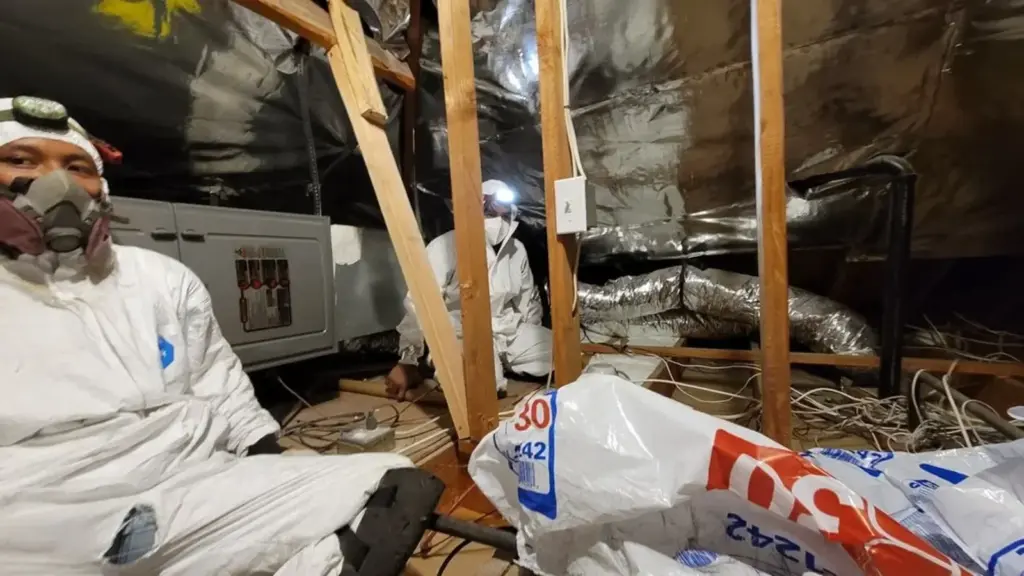
One type of contractor arrives with clear documentation, a defined process, and specific answers to every question below. They carry a current California Contractors State License Board (CSLB) license in the appropriate classification, maintain general liability and workers’ compensation insurance, and can name the disposal facility they use. Their crew uses industrial-grade negative air pressure equipment and HEPA-filtered vacuums during removal. They walk the attic before quoting, document existing conditions with photos, and provide a written scope of work.
This type of contractor will also be transparent about what happens after removal. They can explain how they assess the attic deck and framing before new insulation goes in, and they’ll reference the preparation steps that are easy to overlook, sealing penetrations, checking for moisture staining, confirming that HVAC components are protected during the job. For a closer look at that post-removal phase, the attic prep checklist for Camarillo homes covers exactly what should happen between old material coming out and new insulation going in.
Option B: The Lower-Bid Contractor With Gaps in Their Process
A second type of contractor offers a lower number without a detailed scope. They may not pull permits when required, skip the pre-job attic inspection, or use standard shop-vac equipment rather than commercial insulation removal machines with proper filtration. Disposal may be handled informally. Insurance documentation may be delayed or incomplete when requested.
If you want it handled correctly the first time, consider professional attic insulation in Malibu.
None of this is immediately visible from a phone call or a short visit. It only becomes apparent when you know which questions to ask and what a complete answer sounds like. The comparison of DIY versus professional removal is a useful reference here, the risks that make DIY inadvisable for most homeowners are the same risks that a less rigorous contractor may be cutting corners on.
The goal of vetting is not to find the cheapest option or the most expensive one, it’s to confirm that whoever you hire has the training, equipment, and accountability to do the job safely and completely.
The Comparison: What to Ask and What to Listen For
The table below covers the six most important evaluation criteria when comparing insulation removal contractors in Camarillo. Use it as a scorecard during or after your calls.
| Question / Criterion | Strong Answer | Weak or Vague Answer | Why It Matters |
|---|---|---|---|
| CSLB License & Classification | Provides license number immediately; classification covers insulation or general building | “We’re licensed” without a number, or delays providing documentation | California requires contractor licensing for this work; you can verify the number at cslb.ca.gov |
| Insurance (Liability + Workers’ Comp) | Offers to send a certificate of insurance naming you as additionally insured | Says they’re covered but can’t send documentation before the job | Without workers’ comp, an injury on your property may become your liability |
| Removal Equipment & Dust Control | Describes commercial insulation vacuum with HEPA filtration, negative pressure in attic, and sealed containment at access point | Mentions shop vacs or manual bagging without describing filtration or containment | Inadequate equipment spreads particulates through the living space during removal |
| Disposal Method & Documentation | Names a licensed disposal or recycling facility; can provide a waste manifest if requested | “We take care of it” or “we haul it away” without specifics | Improper disposal can create liability for the homeowner; older materials may require regulated disposal |
| Pre-Job Attic Inspection | Schedules a physical inspection before quoting; documents existing insulation depth, type, and any contamination | Quotes over the phone based on square footage alone | Camarillo attics vary widely in access, existing material type, and condition, a phone quote can’t account for this |
| Written Scope of Work | Provides a line-item written proposal covering removal, containment, cleanup, and what is excluded | Verbal estimate only, or a single-line invoice with no detail | A written scope protects both parties and gives you a basis for comparison across bids |
Additional Questions Worth Asking
Beyond the table above, a few more questions consistently separate thorough contractors from those who are less prepared.
How do you handle suspected rodent contamination or older insulation materials?
Camarillo’s mix of older housing stock and proximity to open agricultural land means rodent activity in attics is more common than in newer, tighter construction. A contractor who has handled contaminated insulation before will describe their protocol clearly: sealed removal bags, protective equipment for the crew, and coordination with any necessary sanitation steps before new insulation is installed. If they haven’t thought about this scenario, that’s worth noting.
For more context on what triggers removal in the first place, the guide to recognizing when removal is necessary walks through the most common indicators Camarillo homeowners encounter.
Many Malibu homeowners rely on expert attic insulation in Malibu for exactly this.
Will you inspect the attic deck and framing before installing new insulation?
Removal without a post-clearance inspection can mean new insulation goes over unaddressed moisture damage, unsealed penetrations, or compromised framing. A contractor who integrates removal and installation should describe a clear inspection step between the two phases.
Are permits required for this work in Camarillo, and will you pull them?
Permit requirements vary by scope and jurisdiction. A contractor familiar with Camarillo’s building department will be able to answer this directly and should be willing to pull any required permits rather than asking you to handle it yourself. Requirements vary by area, confirm with your local building department if you’re uncertain.
What is your crew’s experience with limited-access attics?
Many Camarillo homes, particularly those built in the 1970s and 1980s, have attic access points that are narrow or awkwardly positioned. Experienced crews have handled these configurations before and can describe how they manage hose routing and equipment placement without damaging drywall or ceiling finishes.
Which Type of Contractor Is Right for Camarillo Homes?
The honest answer is that most Camarillo homeowners are best served by a contractor who checks every box in the table above, even if their bid is not the lowest. The reason is straightforward: attic insulation removal is not a visible finished product. Once new insulation is in place, there’s no easy way to confirm that the removal was thorough, that contaminated material was properly disposed of, or that the attic deck was inspected before the new layer went in. The only protection you have is the process the contractor followed before and during the job.
That said, a high bid is not automatically a sign of quality, and a mid-range bid from a fully credentialed contractor who answers every question clearly is often the better choice over a premium bid from someone who is vague about their process. Use the questions and table in this guide to compare on substance, not just on price.
For a deeper look at what drives the overall scope and complexity of removal projects in this area, the breakdown of Camarillo insulation removal cost factors explains the variables that affect project scope, useful context when you’re reviewing written proposals side by side.
If you’re ready to have a Camarillo-based professional evaluate your attic and provide a written scope, our attic insulation removal service page explains the full process and how to get started.
Frequently Asked Questions
Ready for the next step? Learn how attic insulation services in Malibu can help and reach out to the team.
Do insulation contractors in Camarillo need a specific license for removal work?
California contractors performing insulation removal and installation typically operate under a CSLB license, most commonly a C-2 (Insulation and Acoustical) or B (General Building) classification. You can verify any license number at the CSLB’s public lookup tool. Requirements vary by scope, so confirm with your contractor which classification applies to your project.
How do I know if my attic insulation contains materials that need special handling?
Homes built before the mid-1980s may contain insulation materials that require more careful removal protocols. A qualified contractor will identify the insulation type during their pre-job inspection and adjust their handling procedures accordingly. If there’s any uncertainty, they should be able to describe how they determine the material type before work begins.
Is it reasonable to ask for references from a Camarillo insulation contractor?
Yes, and a contractor with consistent local experience should be able to provide them. References from Camarillo or nearby Ventura County projects are more relevant than those from distant service areas, since local work reflects familiarity with the region’s housing stock, climate conditions, and disposal requirements.
What should a written proposal include for an insulation removal job?
A complete written proposal should cover the scope of removal (which areas, what material type), the containment and dust control methods, the disposal approach, any exclusions, and what happens after removal before new insulation is installed. If the contractor is also handling reinstallation, the new material type, depth, and R-value target should be specified separately.
How long does attic insulation removal typically take for a Camarillo home?
Duration depends on attic size, access conditions, insulation type, and whether contamination is present. A contractor who has inspected your attic in person should be able to give you a realistic time estimate as part of their written proposal. Be cautious of estimates given without a physical inspection, since Camarillo attics vary considerably in layout and condition.
Can I stay in my home during insulation removal?
In most cases, yes, provided the contractor uses proper containment at the attic access point and appropriate filtration equipment. A professional crew will seal the access area and use negative pressure to prevent particulates from entering living spaces. Ask your contractor specifically how they manage this, and confirm their answer before scheduling the work.
Making a Confident Decision
Choosing an insulation contractor in Camarillo doesn’t have to be a guessing game. The questions in this guide give you a consistent framework for every conversation, and the comparison table makes it straightforward to evaluate bids side by side on the factors that actually matter. License status, insurance, equipment quality, disposal transparency, and a written scope of work are the foundations of a job done right.
When you’re ready to move forward, reach out to schedule an in-attic inspection. A written proposal based on an actual look at your attic is the clearest starting point for any removal project in Camarillo.