
Choosing Attic Insulation Materials for Camarillo Homes
When attic insulation is underperforming, the consequences don’t announce themselves loudly. Instead, they show up quietly: rooms that never quite cool down in August, heating bills that creep higher each winter, and an HVAC system that runs longer than it should to maintain a comfortable temperature. In Camarillo, where the climate sits at a unique intersection of coastal marine influence and inland heat events, the wrong insulation material can undermine your home’s efficiency for years before you connect the dots. Choosing the right product from the start, matched to the specific conditions of Ventura County’s coastal valleys, makes a measurable difference in long-term comfort and energy use.
This guide compares the three insulation approaches most relevant to Camarillo attics: fiberglass batts and blown-in, cellulose, and radiant barriers. Each option performs differently depending on your home’s age, construction type, and how your attic is used. Understanding those differences helps you have a more informed conversation with a contractor and avoid materials that are a poor match for the local environment. For a full picture of how contractors are evaluated and what the installation process involves, see professional attic insulation installation in Camarillo.
Why Camarillo’s Climate Shapes the Insulation Decision
Camarillo occupies a transitional climate zone that doesn’t behave like coastal Santa Barbara or inland Simi Valley. The city sits in the Oxnard Plain, where cool marine air from the Pacific regularly moderates summer temperatures, but periodic heat events, especially in late summer and early fall, push attic temperatures well above what most homeowners expect. Attics in Camarillo can reach high temperatures during a Diablo wind event even when the street-level temperature feels mild.
This means Camarillo homes face a dual challenge: they need insulation that holds conditioned air in during moderate, fog-influenced days and blocks radiant heat gain during those periodic spikes. Homes built in the 1970s and 1980s, which make up a significant portion of Camarillo’s housing stock in neighborhoods like Mission Oaks, Springville, and Las Posas Estates, often have original fiberglass batts that have settled, compressed, or absorbed moisture over the decades. That compressed insulation may show the right R-value on paper while delivering significantly less performance in practice.
Moisture is also a consideration that gets underestimated in coastal communities. While Camarillo isn’t prone to heavy rainfall, marine layer intrusion and temperature fluctuations can create condensation conditions in attic spaces, particularly in homes without adequate ventilation. The insulation material you choose should be evaluated not just for its R-value but for how it handles occasional moisture exposure without degrading or supporting mold growth.
If you’re uncertain whether your current setup is an insulation problem, a ventilation problem, or both, this comparison of ventilation and insulation strategies for Camarillo heat can help clarify which issue is actually driving your comfort problems.
Option 1: Fiberglass Insulation
Fiberglass is the most widely installed attic insulation material in Camarillo homes built before 2000. It comes in two forms: batts (pre-cut panels that fit between joists) and blown-in loose-fill. Both use glass fibers to trap air and slow heat transfer, but they perform quite differently in real-world attic conditions.
Fiberglass Batts are the familiar pink or yellow panels most homeowners have seen. They’re straightforward to install in open, unobstructed attic floors, and they don’t settle significantly over time when properly installed. The challenge in Camarillo’s older housing stock is that original batt installations often have gaps, compression from foot traffic or storage, and missing sections around HVAC equipment. A batt that has been compressed to half its original thickness loses a substantial portion of its insulating capacity, which is why a visual inspection often reveals performance gaps that an R-value label alone wouldn’t predict.
Blown-In Fiberglass addresses many of the coverage problems that batts leave behind. The loose-fill material conforms around joists, pipes, wiring, and other obstructions, creating a more consistent thermal layer. It’s a practical choice when adding insulation on top of existing material, since contractors can blow it directly over old batts to bring the total R-value up to current California Title 24 recommendations. Blown-in fiberglass is also resistant to moisture absorption, which suits Camarillo’s marine layer environment reasonably well.
If you want it handled correctly the first time, consider professional attic insulation in Malibu.
Fiberglass is non-combustible and does not support mold growth, both meaningful advantages. Its main limitation is that it insulates primarily by slowing conductive and convective heat transfer but does little to address radiant heat, the dominant driver of attic temperature spikes during Camarillo’s heat events.
Option 2: Cellulose Insulation
Cellulose is made from recycled paper fiber, typically treated with borate compounds for fire and pest resistance. It’s installed exclusively as blown-in loose-fill and has been gaining ground as a preferred material for retrofitting older homes, particularly where environmental considerations matter to the homeowner.
One of cellulose’s practical advantages in Camarillo’s existing housing stock is its ability to fill irregular cavities and settle into tight spaces around older framing. Homes in the Las Posas and Mission Oaks areas often have attic floor configurations that don’t lend themselves to clean batt installation, and blown cellulose handles those conditions well. It also achieves a higher density than blown fiberglass at comparable depths, which contributes to its performance in reducing air movement through the insulation layer.
Cellulose has a higher capacity to absorb and release moisture than fiberglass without immediately losing its structural integrity, a property sometimes described as hygric buffering. In a coastal climate like Camarillo’s, this can be an advantage during mild, fog-heavy periods, though it also means that sustained moisture exposure is a greater concern. Cellulose that gets wet and stays wet can compact, lose R-value, and in extreme cases support mold. Proper attic ventilation is therefore more critical when cellulose is the chosen material.
From a pest-resistance standpoint, the borate treatment in cellulose provides some deterrent effect against insects, which is a secondary but relevant consideration in Ventura County where attic pest activity is a known issue. If your attic has had rodent or pest intrusion, that situation should be addressed before any new insulation is installed, regardless of material choice. For more on recognizing when old insulation needs to come out before new material goes in, this overview of signs your Camarillo attic insulation needs removal covers the key indicators.
Option 3: Radiant Barriers
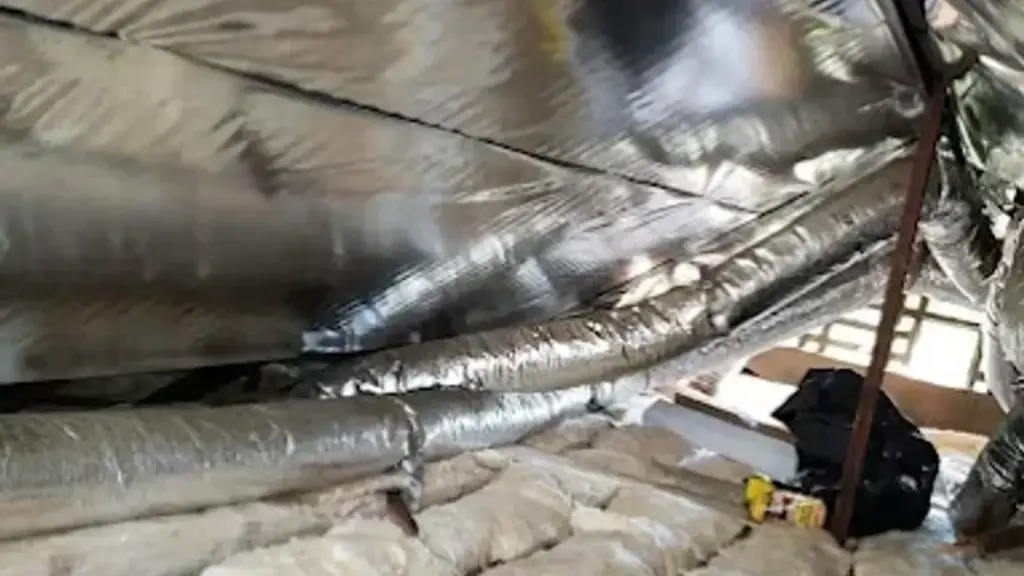
A radiant barrier is a reflective material, usually aluminum foil laminated to a substrate, installed in the attic to reflect radiant heat rather than absorb and slow it. It works on a fundamentally different principle than fiberglass or cellulose: instead of adding thermal mass or trapping air, it bounces radiant energy back toward its source before it can heat the attic floor and the living space below.
Radiant barriers are most effective in climates where cooling loads dominate, and Camarillo’s periodic heat events make them a legitimate consideration even in a generally moderate climate. During a late-summer heat spike, attic surface temperatures can reach levels where a radiant barrier reduces the heat load transferred to the attic floor significantly. California’s energy code has recognized this, and radiant barriers are listed as a compliance pathway under Title 24 in certain climate zones.
Many Malibu homeowners rely on expert attic insulation in Malibu for exactly this.
The important caveat is that radiant barriers work best when there is an air gap between the reflective surface and the material it’s protecting. They’re typically installed on the underside of roof rafters, facing down toward the attic floor. They are not a substitute for mass insulation; a home that has a radiant barrier but inadequate R-value in the attic floor will still lose conditioned air through conduction during cooler months. The most effective approach in Camarillo combines a radiant barrier on the roof deck with adequate blown-in insulation on the attic floor, addressing both radiant and conductive heat transfer.
Radiant barriers require minimal maintenance and don’t degrade from moisture exposure the way cellulose can. They’re particularly worth considering in homes with west-facing or south-facing roof planes that receive extended direct sun exposure during Camarillo’s heat events.
Comparison: Fiberglass vs. Cellulose vs. Radiant Barrier for Camarillo Attics
| Criteria | Fiberglass (Blown-In) | Cellulose | Radiant Barrier |
|---|---|---|---|
| Primary Heat Transfer Addressed | Conductive and convective | Conductive and convective | Radiant only |
| Moisture Tolerance | Good; resists absorption | Moderate; buffers moisture but can compact if sustained | Excellent; unaffected by moisture |
| Retrofit Suitability (Older Camarillo Homes) | High; blows over existing material easily | High; fills irregular framing well | Moderate; requires rafter access, best during re-roof |
| Pest/Mold Resistance | Does not support mold; no pest deterrent | Borate treatment deters insects; mold risk if wet | No organic material; no pest or mold risk |
| Effectiveness During Heat Spikes | Moderate; slows heat but doesn’t reflect it | Moderate; similar to fiberglass | High; reflects radiant load before it enters attic floor |
| Works as Standalone Solution | Yes, when installed to target R-value | Yes, when installed to target R-value | No; must be combined with mass insulation |
Which Is Right for Camarillo Homes?
There is no single answer that fits every Camarillo attic, but the local conditions do point toward some clear patterns.
For most Camarillo homes built in the 1970s through 1990s, blown-in fiberglass or cellulose installed over existing material is the most practical starting point. These homes typically have compressed or incomplete batt insulation that needs supplementing, and blown-in material handles the uneven attic floor conditions common in that era of construction. Cellulose tends to be the better fit when the attic floor has many obstructions and the homeowner wants a denser fill; fiberglass blown-in is often preferable when moisture management is a higher priority or when the contractor is topping up an existing fiberglass system.
For homes with significant sun exposure on south or west-facing roofs, or for any homeowner whose primary complaint is summer heat gain rather than winter heat loss, adding a radiant barrier alongside blown-in mass insulation is worth serious consideration. The combination addresses both the radiant spike during heat events and the steady-state conductive loss that mass insulation handles. This pairing is particularly well-suited to Camarillo homes in areas like Springville or Sterling Hills where lot orientation and minimal tree cover mean extended direct sun exposure.
Homes that have experienced rodent intrusion, pest activity, or moisture damage should have the existing insulation assessed and potentially removed before any new material is added. Installing new insulation on top of contaminated or moisture-damaged material wastes the investment. A thorough attic assessment before installation is the step that separates a lasting result from one that underperforms within a few years.
Understanding the factors that influence what your specific project will involve, beyond just material selection, is covered in detail at what drives attic insulation costs in Camarillo. And when you’re ready to talk to a contractor, having a list of the right questions prepared makes a significant difference in the quality of the conversation. Questions to ask attic insulation contractors in Camarillo gives you a practical framework for that process.
Ready for the next step? Learn how attic insulation services in Malibu can help and reach out to the team.
Frequently Asked Questions
Can I add new insulation on top of my existing attic insulation in Camarillo?
In most cases, yes. If the existing material is dry, undamaged, and free of pest contamination, blown-in fiberglass or cellulose can be added directly on top to bring the total R-value up to current standards. A contractor should inspect the existing material first to confirm it’s in suitable condition before adding new insulation over it.
Does a radiant barrier replace the need for attic floor insulation?
No. A radiant barrier reflects radiant heat but does not slow conductive heat transfer, which is what mass insulation handles. In Camarillo’s climate, a radiant barrier works best as a complement to adequate blown-in insulation on the attic floor, not as a standalone solution.
How do I know if my Camarillo home’s current insulation is still performing?
Signs of underperforming insulation include rooms that feel significantly warmer than the thermostat setting, HVAC systems that run for long cycles, and visible settling or gaps in the attic floor insulation layer. A professional attic inspection can assess actual depth, coverage, and condition in ways a visual check from the attic hatch cannot.
Is cellulose a good choice for Camarillo’s marine layer climate?
Cellulose can work well in Camarillo, but it requires good attic ventilation to manage the moisture it can absorb during marine layer periods. When ventilation is adequate, cellulose’s hygric buffering properties are manageable; when ventilation is poor, sustained moisture exposure becomes a risk. A contractor familiar with Ventura County conditions can assess whether your attic’s ventilation is sufficient before recommending cellulose.
What R-value is recommended for Camarillo attics?
California Title 24 energy code sets minimum R-value requirements that vary by climate zone, and Camarillo falls within a zone where attic insulation recommendations generally target the higher end of the residential range. Requirements also vary based on the home’s age and whether the project is a retrofit or new construction. A licensed contractor can confirm the applicable standard for your specific home and permit situation.
Should I be concerned about fire safety with cellulose insulation?
Cellulose used in residential attic applications is treated with fire-retardant compounds, typically borates, as part of the manufacturing process. It meets applicable fire safety standards for attic use. That said, any insulation material should be kept clear of recessed light fixtures that are not rated for insulation contact, and a qualified installer will know to observe those clearances during installation.
Ready to Choose the Right Material for Your Camarillo Attic?
Selecting the right insulation material is the first decision, but getting it installed correctly for your specific attic configuration and Camarillo’s local climate conditions is what determines whether the investment actually delivers. LA Attic Pro works with Camarillo homeowners to assess existing conditions, recommend the appropriate material combination, and complete attic insulation installation in Camarillo to a standard that holds up over time. Reach out to schedule an attic assessment and get a clear picture of what your home actually needs.