
What “Cost Per Square Foot” Really Means in Los Angeles
Ask five people what insulation should cost per square foot and you’ll hear five different answers. That’s because the number floating in a conversation is usually shorthand for a bundle of activities and conditions that rarely match from house to house. In Los Angeles, where homes stretch from post-war bungalows to hillside contemporaries with complex roofs, a meaningful conversation about cost per square foot starts with context: What’s the state of the existing insulation? How accessible is the work area? Which materials and performance targets are appropriate for your microclimate? Without those details, a per-square-foot figure can mislead more than it guides.
Homeowners often begin with online research and calls to local professionals who handle insulation installation. They quickly discover that square footage is only the first variable. The attic’s shape, the presence of ducts or storage platforms, the condition of electrical and lighting fixtures, and the need for air sealing or ventilation adjustments all influence the scope. That’s why a thorough site visit remains the gold standard for accurate planning. A crew that measures, photographs, and maps out your attic or crawlspace can explain precisely what the square foot metric covers in your case.
Deconstructing the Square Foot
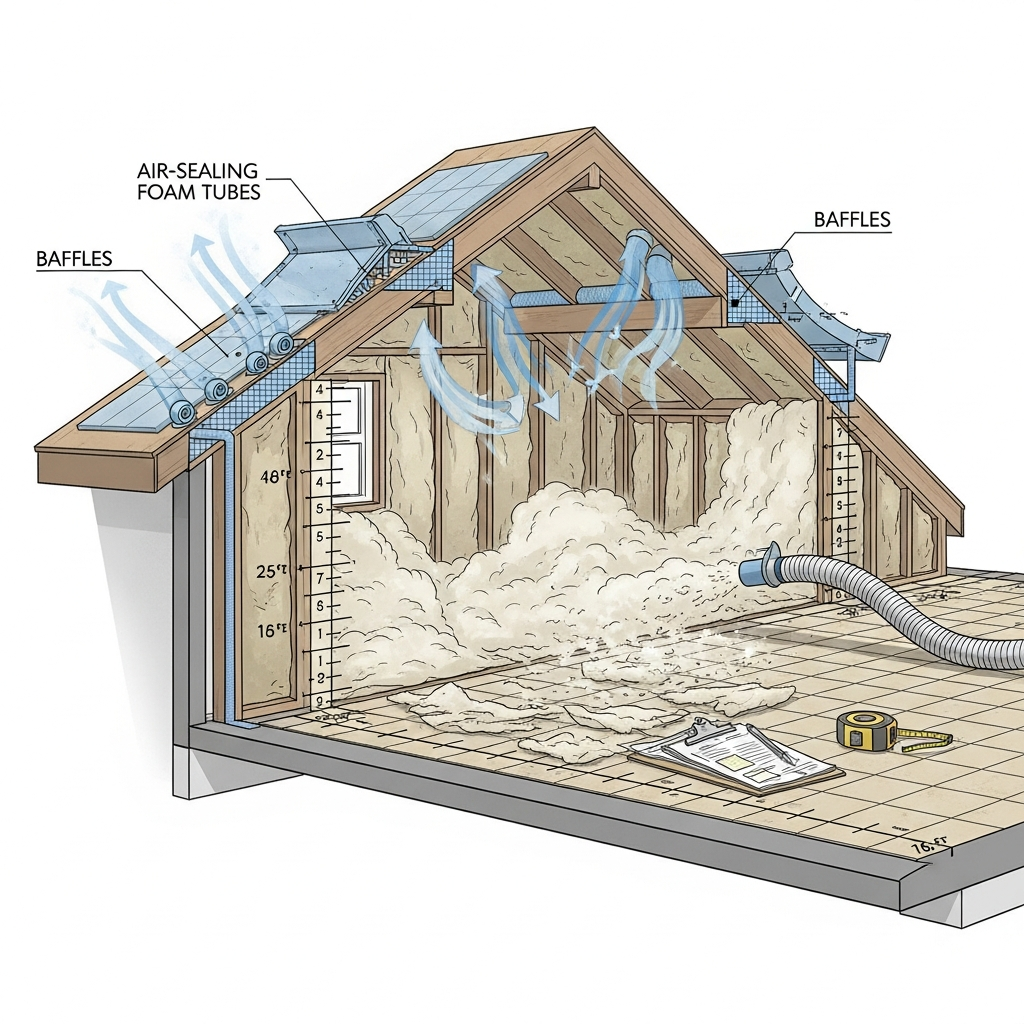
Think of one square foot of insulation not as a static product but as a service zone. In that zone, the crew may need to travel across joists safely, move and replace stored items, seal top-plate gaps, box in a can light, install a soffit baffle, and finally place or blow insulation at a specified density. If a similar square foot in a neighboring home requires none of those steps because the area is open and clean, the effort is not equivalent. The square footage stays the same; the conditions do not. Recognizing this difference helps you interpret proposals with clarity and confidence.
Ceiling height and roof pitch add nuance. A low-slope roof with tight clearances slows movement, while a steep pitch with generous headroom allows faster coverage. Trussed roofs have more interruptions than simple rafter framing. Skylight wells, chimneys, and HVAC platforms create pockets that must be sealed and insulated carefully to avoid thermal shortcuts. Each of these details affects the time it takes to complete one “square foot” of work and the sequence in which tasks are executed.
Materials, Depth, and Performance Targets
Not all square feet achieve the same thermal performance. One approach may prioritize air sealing with a thorough pass of foam and caulk before topping with loose-fill. Another may specify high-density batts fitted into joist bays. Spray foam at the roofline entirely reframes the assembly, reducing air exchange and bringing ducts into a milder environment. When you see per-square-foot figures tied to these different methods, remember that you’re comparing not just materials but assemblies. Ask what the number includes: preparation, protection of fixtures, ventilation safeguards, and documentation of results.
Performance targets are equally significant. Los Angeles energy standards point to certain R-values, but the path to those targets can vary in material thickness and density. A proposal that assumes thorough air sealing plus a uniform blanket of loose-fill may outperform a higher nominal R-value that is poorly detailed, simply because continuity beats raw thickness in many real-world attics. This is one reason it pays to evaluate the plan for edges, penetrations, and transitions as closely as the headline figures.
Existing Conditions Drive Real-World Effort
Per-square-foot comparisons often ignore the cost of undoing yesterday’s shortcuts. Many attics hide a mix of partial batts and thin loose-fill that looked generous at a glance but left gaps at the perimeter. Others have contamination from rodents or construction debris, requiring careful removal. Some have can lights that demand protective covers to keep insulation at a safe distance, while older wiring or flues call for special clearances. The difference between a quick top-off and a full remediation is night and day, yet both are frequently collapsed into a single square-foot expectation when homeowners first start shopping.
Access is another overlooked factor. A tiny scuttle over a closet means ladders and careful staging; a full-size hatch with pull-down stairs speeds the work. Homes with finished garage ceilings or decorative beams can limit how and where crews move equipment. Multi-level roofs demand more setup and safety measures. These details change the labor needed to serve each square foot but rarely appear in generic figures.
How to Read and Compare Proposals
The most useful proposals explain what their per-square-foot figure includes and what it assumes. Do they plan to remove existing insulation? Are air sealing and baffles included? How are recessed lights and bath fans handled? Will the crew photograph key steps for your records? When those elements are spelled out, you can compare plans on equal footing. If two quotes differ materially, ask each contractor to walk you through the path to a continuous, safe, code-compliant assembly rather than anchoring solely to a single unit number.
Transparency benefits both sides. When a contractor explains why a complex roofline or an older home requires more preparation, you can see how that investment translates into daily comfort and stability. On the other hand, if your attic is clean, open, and primed for a simple top-off, a straightforward plan should reflect that. Either way, clarity prevents misunderstandings and sets expectations for the day of installation.
Why Los Angeles Homes Defy “Average”
It’s tempting to look for a citywide average, but Los Angeles rarely plays by averages. Coastal fog zones, inland heat pockets, hillside wind channels—each home negotiates the climate in its own way. Architectural styles compound the differences. A 1920s Spanish with small, scattered attic spaces behaves unlike a 1960s ranch with a broad, accessible cavity. The square footage might be the same on paper; the lived experience will not be. That’s why local expertise matters. Installers who have climbed through hundreds of attics in our area recognize patterns quickly and tailor the plan accordingly.
Neighborhood context matters as well. Proximity to busy roads may elevate the priority of acoustic performance; older neighborhoods might add a focus on safe integration with legacy wiring; homes under flight paths could call for denser, more continuous coverage. Each of these choices nudges the per-square-foot value because the square foot doesn’t exist in a vacuum—it lives in a specific place, with specific goals.
Value Per Square Foot, Not Just Cost
Another way to think about the metric is value delivered per square foot. If one approach yields steadier temperatures, fewer hot spots, and measurable reductions in HVAC run time, its worth extends beyond the raw number in a spreadsheet. Value shows up in everyday quality of life: a nursery that stays calm through a Valley afternoon, a home office that doesn’t need a fan to be comfortable during a video call, or a bedroom that feels the same in the morning as it did at bedtime. Those outcomes depend on the integrity of the assembly, not just the headline thickness or a single unit price.
In the middle of your evaluation, come back to the fundamentals: is the plan continuous, well-ventilated, and compatible with your roof and mechanicals? Does it include air sealing and safe handling of lights and flues? And will the team executing it document their work so you can see exactly what you’re getting? Homeowners who center these questions and the craft of insulation installation tend to feel more satisfied with the result and less preoccupied with a single unit figure.
What to Expect on Installation Day
Regardless of material, a well-run job follows a calm rhythm: protect floors and access paths, remove or redistribute stored items, address air leaks, install baffles, stage equipment, and then place or blow insulation with attention to density and even coverage. Crews photograph key stages, label service areas, and tidy before leaving. If removal is required, negative-pressure vacuums and sealed hoses keep dust controlled. Throughout, a lead technician communicates progress and any surprises so you always understand what’s happening overhead.
After completion, you should notice differences quickly. Rooms under the attic feel more stable. The home warms up and cools down more slowly, allowing your thermostat to work less frantically. If you track energy use, you’ll often see smoother patterns right away. These are the signs of an assembly that’s performing as intended, and they’re a direct reflection of the care invested in each square foot.
Frequently Asked Questions
Does a higher per-square-foot figure always mean better performance?
Not necessarily. The quality of preparation and continuity often matters more than headline thickness or a single metric. Compare scope details—air sealing, ventilation, fixture protection, and documentation—alongside the figure.
Can I estimate my project by measuring my home’s footprint?
It’s a start, but attics frequently don’t match the home’s exact footprint, and usable area depends on framing, platforms, and obstructions. A site visit refines the number and clarifies what each square foot entails.
What materials are commonly priced by the square foot?
Loose-fill fiberglass or cellulose, fiberglass batts, and certain spray foam applications are often presented with per-square-foot figures. Just remember those figures reflect assumptions about preparation and depth that should be spelled out.
Will air sealing be included in a per-square-foot quote?
Sometimes, but not always. Because air sealing is highly specific to each home, it should be listed in the scope and described clearly so you know what’s covered.
How does attic access affect my project?
Smaller hatches, steep pitches, or tight truss webs slow movement and increase the care required to reach every corner. Better access speeds work and can simplify logistics, which may be reflected in the plan.
What kind of documentation should I expect?
Depth markers, photos of air sealing and baffle placement, notes on material type and coverage, and a summary of any special treatments near lights or flues are all helpful records for future reference.
If you’re ready to move from rough estimates to a plan that reflects your home’s real conditions, connect with a local specialist who values clear scope and careful insulation installation. Start with a tailored assessment and take the guesswork out of the square-foot conversation so you can focus on the comfort you’ll feel every day.