
Signs of Damaged Attic Ducts in Your Camarillo Home
What does it actually feel like when your attic ductwork is failing? Most Camarillo homeowners notice it as a vague discomfort: one bedroom that never quite cools down in August, a utility bill that climbs a little higher every summer, or a faint musty smell that shows up whenever the AC kicks on. These aren’t random annoyances. They are the house communicating that something is wrong inside the attic, where the ductwork runs through temperatures that can exceed 140°F on a hot Ventura County afternoon. This article walks through the clearest warning signs so you know exactly when it’s time to schedule a professional evaluation for attic duct replacement.
Why Camarillo’s Climate Is Unusually Hard on Ductwork
Camarillo sits in a coastal-influenced inland valley where temperatures swing dramatically between seasons and even between morning and afternoon. During summer, the attic absorbs radiant heat all day long, and flexible duct assemblies that run through that space are exposed to thermal stress that most homeowners never think about. The outer jacket expands in the heat and contracts overnight, and over years that repeated cycling degrades the insulating wrap, loosens connections at boots and plenums, and can cause the inner liner to separate or collapse.
Many homes in Camarillo and the broader Los Angeles metro were built during the tract-home boom of the 1970s through the 1990s. The flex duct systems installed in that era were often rated for a service life of around 15 to 25 years under typical conditions. In a hot attic without adequate insulation, that lifespan shortens considerably. If your home is more than two decades old and the ductwork has never been touched, the odds are meaningful that at least some of it is compromised. Understanding the connection between attic heat and duct deterioration helps explain why the climate here accelerates what would otherwise be slow, gradual wear.
The Most Telling Signs Your Ducts Are No Longer Working Properly
Not every symptom is dramatic. Ductwork rarely fails all at once the way a pipe bursts. Instead, it degrades gradually, and the signs accumulate until the system’s performance drops below what the household can comfortably tolerate. Here are the patterns that consistently point toward duct damage.
Rooms that won’t reach the set temperature. When conditioned air leaks out of a disconnected joint or a torn liner before it reaches the register, the room at the end of that duct run stays warm in summer and cool in winter regardless of how long the system runs. If you have one or two rooms that consistently feel out of step with the rest of the house, the supply duct serving those rooms is the first place to investigate. This is different from a thermostat placement issue or a closed damper; the symptom is persistent and room-specific.
Noticeably higher energy bills without a clear cause. A system that is losing conditioned air into the attic has to run longer to satisfy the thermostat. That extra runtime shows up directly on the utility bill. If your summer electricity costs have been creeping upward year over year without a corresponding change in usage habits or rate increases, the HVAC system’s efficiency is worth examining. Leaky ducts are one of the most common hidden contributors to this pattern in older Camarillo homes.
Excessive dust at supply registers. When duct connections are loose, the system can draw unconditioned attic air, fiberglass particles, or debris into the return side and push it through the supply registers. If you find yourself wiping dust off furniture and vents more frequently than seems normal, or if the air coming from a register smells faintly of insulation or mildew, that is a meaningful signal. It suggests the duct system is no longer sealed and is pulling from spaces it should not be accessing.
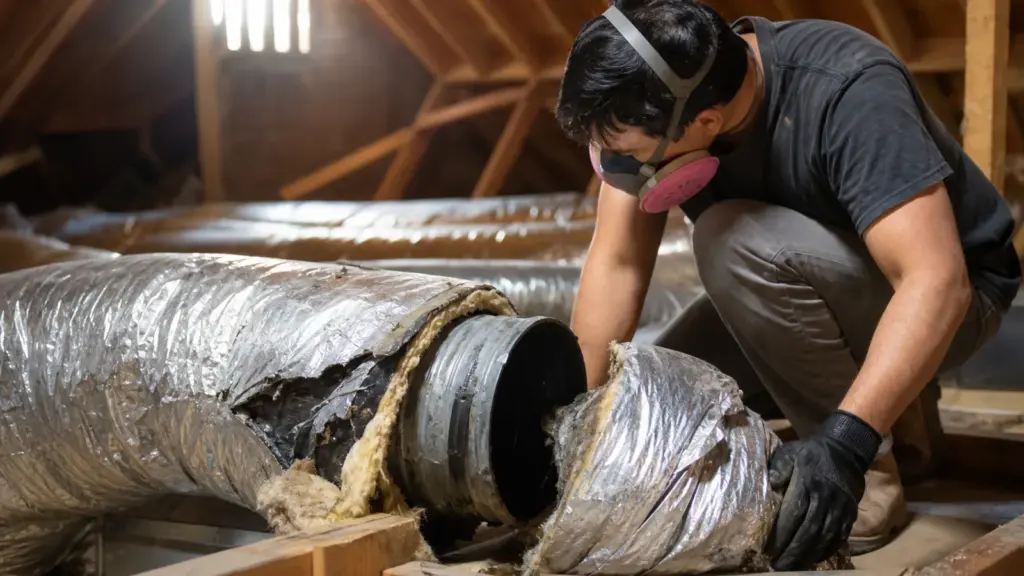
Visible damage in the attic. If you or a contractor has looked in your attic recently, obvious physical signs include flex duct that has sagged and kinked, foil-faced wrap that is torn or missing sections, disconnected collars at the air handler or at register boots, and insulation that has pulled away from the duct surface. Any of these conditions will reduce airflow and allow heat transfer that defeats the purpose of the insulation entirely.
The system runs almost continuously on moderate days. An HVAC system that runs nearly nonstop even on days when the outdoor temperature is only mildly warm is working against itself. Some of that conditioned air is escaping before it reaches the living space, so the thermostat never reaches setpoint, and the equipment never cycles off. Beyond the energy waste, that continuous runtime accelerates wear on the air handler and compressor.
If you want it handled correctly the first time, consider professional air duct cleaning in Malibu.
How Damaged Ducts and Poor Attic Insulation Make Each Other Worse
Ductwork and attic insulation are not independent systems. They work together, and when one is compromised, it amplifies the problems caused by any weakness in the other. A duct that runs through an attic with thin or degraded insulation is exposed to far more heat than one that runs through a properly conditioned or well-insulated space. Conversely, even excellent attic insulation provides less benefit if the ducts running through the attic are leaking conditioned air directly into that hot space.
This is why an evaluation that looks at only one system often misses the full picture. When a technician assesses duct condition in a Camarillo attic, the state of the insulation above and around those ducts is directly relevant to the diagnosis. Homes that have had insulation removed for pest remediation or that were never insulated to current standards are particularly vulnerable to this compounding effect. An air duct replacement evaluation will typically note insulation conditions as part of the overall attic assessment because the two are so closely linked.
If you are planning to invest in new ductwork, it makes sense to address insulation at the same time. Running new ducts through an attic that still has inadequate insulation means the new system will underperform from day one. The reverse is also true: adding insulation while leaving deteriorated ducts in place limits how much of that insulation’s benefit you will actually feel inside the house.
What a Professional Duct Evaluation Actually Involves
A proper evaluation goes beyond a visual check. A technician will access the attic and physically trace the duct runs, looking at the condition of the outer wrap, the integrity of all connections, and whether the duct layout makes sense for the home’s floor plan. In many older Camarillo homes, duct systems were installed with longer runs and more bends than current best practices recommend, which compounds any leakage or restriction issues.
Pressure testing is the most objective diagnostic tool. By pressurizing the duct system and measuring how quickly it loses pressure, a technician can quantify the total leakage and compare it against acceptable thresholds. This gives a concrete basis for the recommendation: whether the system needs targeted repairs at a few problem joints, or whether the ductwork has reached the point where full air duct replacement is the more cost-effective path.
It is worth understanding what drives the scope and complexity of a replacement project before any work begins. The factors that affect duct replacement scope include the home’s square footage, the number of zones, the accessibility of the attic, and whether the existing system layout needs to be redesigned for better balance. A technician who explains these variables clearly is giving you the information you need to make a sound decision.
What Happens After the Ducts Are Replaced
Homeowners who have gone through a full duct replacement in a Camarillo attic consistently describe the difference as immediate and noticeable. Rooms that were previously hard to cool reach setpoint more quickly and hold temperature more evenly. The system cycles on and off as designed rather than running in long, inefficient stretches. Supply registers deliver air at the volume and temperature the equipment is producing, rather than a diminished fraction of it.
Many Malibu homeowners rely on expert air duct cleaning in Malibu for exactly this.
The energy savings tend to show up within the first full billing cycle after installation. Because the system is no longer compensating for lost conditioned air, runtime drops, and the compressor and air handler experience less wear. Over time, that reduced strain can extend the useful life of the HVAC equipment itself.
There is also an air quality dimension. A sealed duct system stops pulling attic air, dust, and insulation particles into the living space. Homeowners often report that the air simply feels cleaner, particularly in bedrooms where supply registers are closest to sleeping areas. This is not a medical claim, but it is a practical outcome that many people notice within the first few weeks. For more detail on what the post-installation period looks like, the guide to life after new attic ducts covers the adjustment period and what to watch for.
Frequently Asked Questions
How do I know if the problem is the ducts or the HVAC equipment itself?
A simple starting point is to check whether the air coming directly out of the air handler feels the right temperature while a distant room stays warm. If the equipment is producing conditioned air but it isn’t arriving at certain registers in adequate volume or temperature, the ductwork between the two points is the more likely culprit. A pressure test can confirm this without guesswork. HVAC equipment faults tend to affect the whole house relatively evenly, while duct problems are usually room-specific or zone-specific.
Can damaged ducts be repaired rather than replaced?
In some cases, yes. If the damage is limited to a few disconnected joints or a short section of torn liner, targeted repairs can restore adequate performance. The decision between repair and full replacement comes down to the age of the system, the extent of the damage, and whether the existing layout is well-designed for the home. A technician who has physically inspected the attic can give you a clear picture of which approach makes more sense for your specific situation.
Does replacing ductwork require permits in Camarillo?
Permit requirements for duct work vary depending on the scope of the project and local jurisdiction rules. Requirements in Camarillo and the surrounding Ventura County area can differ from those in Los Angeles city proper. A licensed contractor will be familiar with local requirements and can advise you on what documentation or inspections apply to your project. It is always worth confirming this before work begins rather than after.
How long does attic duct replacement typically take?
For a typical single-story Camarillo home, a full replacement is generally completed within one day. Larger homes, two-story layouts, or attics with limited accessibility may require additional time. Your contractor should be able to give you a realistic timeline after the initial attic inspection, since the actual conditions up there have a significant effect on how the work proceeds.
When to Stop Waiting and Schedule an Evaluation
If your Camarillo home is more than 20 years old and the ductwork has never been inspected, the signs described above are reason enough to schedule a professional look. You do not need to wait until a room becomes completely unconditioned or until the utility bills become alarming. An evaluation is low-cost relative to the work it might prevent or prioritize, and it gives you an accurate picture of what the attic system actually looks like rather than what you assume it looks like.
LA Attic Pro serves homeowners throughout Camarillo and the Los Angeles area, providing attic inspections, professional duct replacement services, insulation assessment, and the full range of attic services that often go together when a home’s attic system needs attention. If any of the signs described here sound familiar, reaching out for an evaluation is the most direct way to get a clear answer about what is actually happening in your attic and what it will take to fix it.